
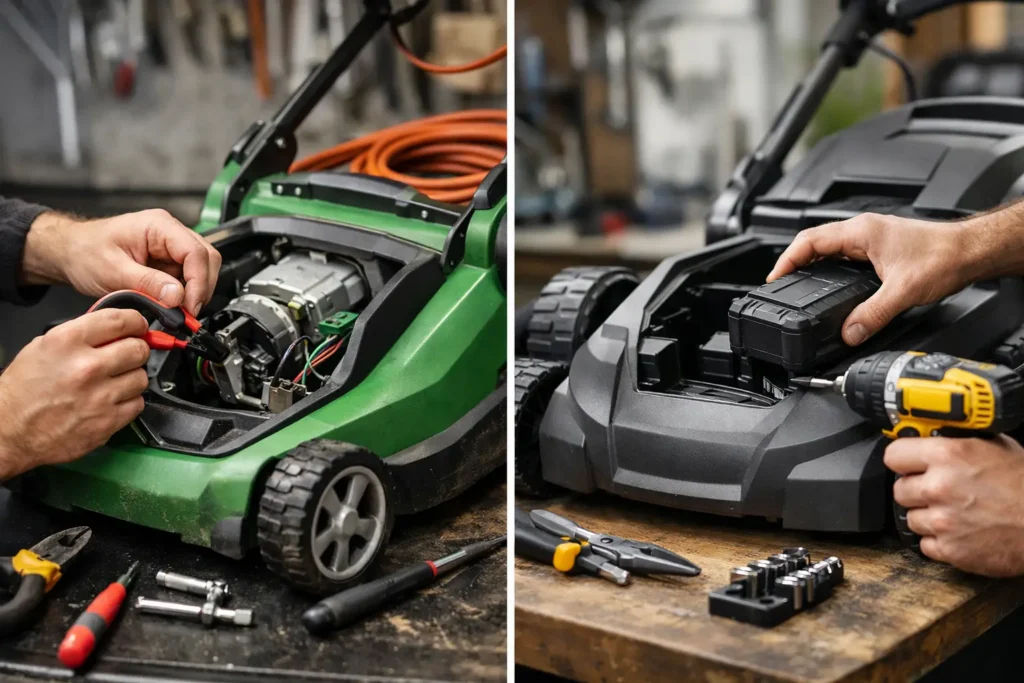
A mower that quits halfway through the yard usually creates the same question fast: fix it, or replace it? With corded mower repair versus battery mower repair, the answer often comes down to what actually failed, how expensive the parts are, and whether the machine still makes sense for your yard.
For Seattle-area homeowners, that decision is not always obvious. Corded and battery mowers may look similar from a distance, but they fail in different ways. One depends on a continuous power connection. The other depends on a battery system, onboard electronics, and charging performance. That difference changes repair cost, repair difficulty, and long-term value.
Corded mower repair versus battery mower repair at a glance
Corded mowers are usually simpler machines. They tend to have fewer expensive electronic components, and that can make diagnosis more straightforward. If a corded mower stops working, the problem is often tied to the extension cord, plug connection, switch, motor brushes, or thermal overload protection. Those are real repairs, but they are usually easier to isolate.
Battery mowers add more convenience, but they also add more variables. A battery pack may be weak even if it still charges. A charger may show a normal light while underperforming. The mower may have control boards, safety sensors, or battery communication issues that are harder to troubleshoot without brand-specific parts and testing.
That does not mean battery mowers are bad choices. It just means the repair path is often less mechanical and more electronic.
How corded mowers usually fail
Corded mowers are often chosen for smaller yards because they are lightweight, quiet, and simple to start. When they break, the good news is that the issue is frequently external to the mower itself. A damaged extension cord, a loose outlet connection, or a tripped breaker can mimic a mower failure.
Inside the mower, the most common trouble spots are the power switch, wiring connections, and the motor. Over time, repeated tugging on the power cord can stress internal wire connections where the cord enters the housing. If the mower cuts in and out when the cord moves, that is a strong clue.
Motor problems can be more serious, but even then, repair decisions are often clear. If the motor is overheating because the blade is dull, bent, or dragging through heavy grass, that may not be a motor problem at all. It may be a maintenance problem. A freshly sharpened blade reduces strain, improves cut quality, and can keep the mower from working harder than it should.
If the motor itself is failing, the economics matter. On lower-cost corded mowers, a full motor replacement may cost more than the machine is worth. On a better-built unit, repair can still make sense if the deck, wheels, and housing are in solid shape.
How battery mowers usually fail
Battery mowers bring freedom from cords, and for many households that convenience is worth it. But when a battery mower stops performing, the problem is not always where people think it is.
Sometimes the mower is fine and the battery is the weak point. Battery packs lose capacity over time, especially if they are stored in extreme temperatures or left discharged for long periods. A mower that starts strong but fades quickly may have a battery nearing the end of its useful life.
Other times, the battery is not the only issue. Chargers fail. Terminals corrode. Safety switches wear out. Control boards can stop communicating properly with the battery pack. Unlike a basic corded mower, a battery model may have multiple interlocks and electronic systems that all need to work together before the blade will spin.
That complexity can make battery mower repair more expensive, especially when replacement batteries are proprietary. In some cases, the repair bill is not really about labor. It is about the cost of a new battery and whether that battery is still available from the manufacturer.
Which is easier to diagnose?
In most cases, corded mowers are easier to diagnose. Power either reaches the mower or it does not. The switch either passes current or it does not. The motor either runs, struggles, or overheats. There are fewer hidden layers.
Battery mowers can be trickier because one symptom may point to several possible causes. A mower that will not start could have a dead battery, a charger issue, a bad contact point, a failed control module, or a safety interlock problem. Without the right tools or parts, diagnosis can turn into guesswork.
For a homeowner who likes DIY repair, that matters. Corded mower troubleshooting is often more approachable. Battery mower troubleshooting can be manageable too, but it tends to involve more part swapping and more uncertainty.
Cost is where the trade-offs show up
When people compare corded mower repair versus battery mower repair, cost is usually the deciding factor.
Corded mower repairs are often lower in total cost because the machines themselves are simpler and the replacement parts are usually less expensive. If the problem is a switch, connection, or damaged cord entry point, repair may be fairly reasonable.
Battery mower repairs can stay affordable if the fix is minor, like a contact issue or a switch. But once the battery pack, charger, or electronic control system is involved, costs can jump quickly. A battery alone can represent a large share of the mower’s original purchase price.
This is where age matters. If a battery mower is already several seasons old and its battery runtime has been dropping, replacing one failed component may not solve the whole problem for long. On the other hand, if the mower is newer and the rest of the system is healthy, replacing a battery may still be worth it.
Blade condition affects both types more than people expect
Not every mower problem starts with power. A dull blade can make either type of mower perform badly, leave ragged grass tips, and put extra strain on the motor. That strain is especially noticeable on electric mowers because they generally do not have the same reserve torque people expect from larger gas equipment.
If your mower sounds strained, cuts unevenly, or seems to bog down in normal grass, the blade deserves a close look. A sharpened, balanced blade helps the mower cut cleaner and run more efficiently. That is one of the most practical ways to extend the working life of the machine you already own.
For local homeowners trying to keep equipment in service rather than replace it too soon, routine blade care often delivers more value than people expect. Sharper Tools LLC sees this firsthand with mower blade sharpening for customers who want better lawn results without adding unnecessary wear to their equipment.
When repair makes sense and when it does not
A corded mower is often worth repairing if the issue is isolated, the body of the mower is still solid, and the machine fits your yard well. Because these mowers are relatively simple, a modest repair can buy several more seasons of use.
A battery mower is worth repairing when the platform is still current, the battery system is still supported, and the overall machine is in good shape. If the deck is sound, the wheels and height adjustment still work properly, and a new battery restores normal runtime, that can be a practical decision.
Repair starts making less sense when parts are discontinued, the battery cost is unusually high, or the mower has multiple signs of age at once. If a battery mower needs a battery, charger, and electronics work, replacement may be more realistic than piecing it together.
Safety matters more with both than many people realize
Corded mowers carry obvious electrical risk because of the power cable. Any repair involving damaged wiring, switch problems, or power entry points should be handled carefully. A quick patch on a compromised electrical connection is not a good long-term answer.
Battery mowers remove the extension cord hazard, but they add high-energy battery components that should also be treated with respect. Damaged battery housings, overheating during charging, or swollen packs are not issues to ignore.
No matter which mower you own, disconnect power before inspecting the blade area, and do not overlook the blade itself. A bent or unbalanced blade can cause vibration, stress bearings, and make a mower feel like it has a larger mechanical problem than it really does.
The practical bottom line for homeowners
If you want the simpler repair path, corded mowers usually win. They tend to be easier to troubleshoot, cheaper to fix, and less dependent on proprietary parts. If your yard size works well with a cord, the long-term repair picture is often more predictable.
If you want convenience and cleaner mobility, battery mowers still have real advantages. Just go in knowing that battery replacement and electronic parts can change the repair math quickly. The best battery mower to repair is usually one from a brand with good parts support and a battery system that is still widely available.
Either way, keeping the blade sharp is one of the smartest maintenance steps you can take. It helps cut quality, reduces strain on the mower, and can delay bigger problems. A well-maintained mower does not just save money. It saves time on the next Saturday when the grass is ready and you need your equipment to work the first time.