A dull chef’s knife usually gives itself away at the worst possible time – halfway through onions for dinner service, or while you are trying to prep a weeknight meal without turning it into a chore. That is when knife sharpening service cost stops being a vague question and becomes a practical one. Most people are not asking for a luxury service. They want to know what they will pay, what they will get back, and whether it is worth it.
What affects knife sharpening service cost?
The short answer is that pricing depends on the knife, its condition, and how the service is delivered. A basic kitchen knife in decent shape costs less to sharpen than a chipped santoku, a long slicer, or a heavily used commercial knife that needs more correction before the edge can be refined.
Size matters, but not always in the way people expect. A small paring knife may be quick to service, while a large chef’s knife or carving knife takes more passes and more attention to keep the angle consistent from heel to tip. Blade condition can matter even more than length. If the edge is simply dull, the work is straightforward. If it is rolled, nicked, or badly worn, the sharpening takes longer and removes more material.
The type of knife also changes the price. Standard Western kitchen knives are usually the most predictable. Serrated knives can cost more because each tooth has to be worked more carefully. Single-bevel or specialty blades may also carry a different rate because they require more specific handling.
Then there is convenience. Walk-in drop-off often costs less than mobile service, pickup and delivery, or commercial route service. That does not mean the higher-priced option is worse value. For a busy household or a restaurant kitchen, convenience is often the whole point.
Typical knife sharpening service cost ranges
For most household customers, knife sharpening service cost is commonly priced per knife. A typical range for standard kitchen knives is often around $6 to $15 each, with premium, oversized, damaged, or specialty knives costing more. In some markets, very basic sharpening may come in below that range, while high-end specialty work can run well above it.
Seattle-area customers should expect local pricing to reflect labor, service quality, and convenience. A provider offering careful edge work, consistent results, and pickup or drop-off options is not competing on the same terms as a low-cost booth doing fast pass-through sharpening. The cheapest ticket is not always the best deal if the edge does not last or the blade loses too much steel.
Some shops use minimum order pricing, which is common when travel or route logistics are involved. If a service includes pickup and return, there may be a flat fee, a neighborhood-based delivery fee, or a minimum number of items. That can make a single knife feel expensive, but a group of knives often pencils out well.
Commercial pricing often works differently. Restaurants, caterers, and food businesses may pay per knife, per visit, or through a recurring service model. If the service includes routine swaps, maintenance schedules, or on-site logistics, the cost reflects reduced downtime and more predictable kitchen performance.
Why prices vary so much from one provider to another
A sharpening service is not just selling a sharper edge. It is selling judgment. The person doing the work has to know how much metal to remove, what angle fits the knife, how to preserve the blade profile, and when to stop before unnecessary wear sets in.
That is why two companies can quote very different prices for what sounds like the same job. One may be doing quick grinding meant to get the knife cutting again fast. Another may be shaping, sharpening, and finishing the edge in a way that improves performance and protects the life of the knife. If you have ever had a knife come back sharp but strangely thinner, uneven, or scratched up, you have already seen the difference.
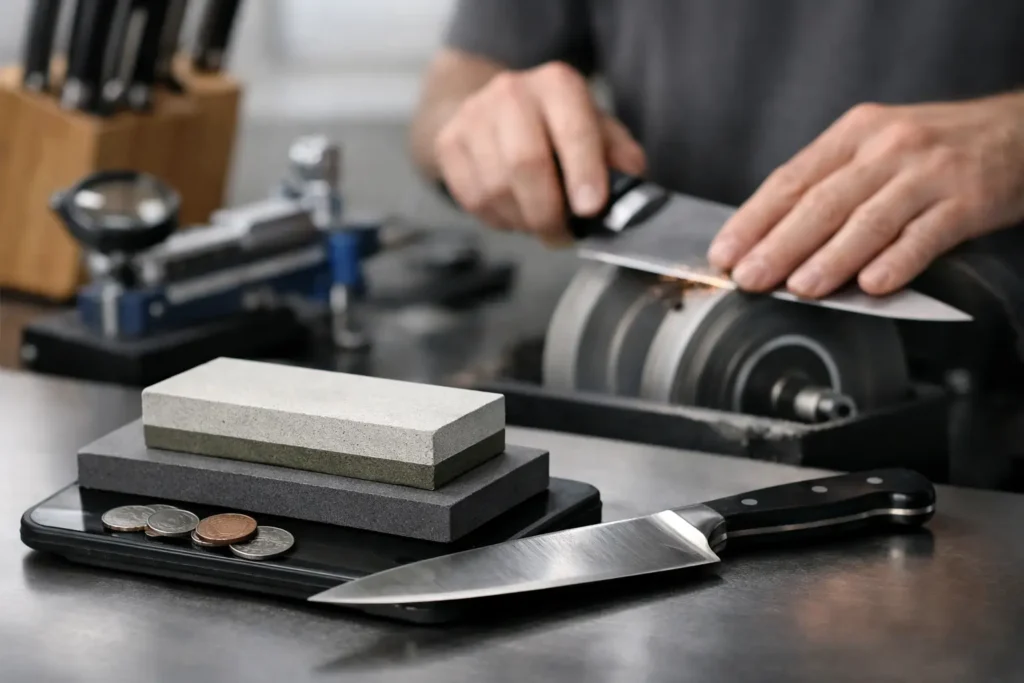
Equipment also plays a role. Some sharpeners rely on systems built for speed. Others combine belt work, stones, honing, and finishing steps based on the blade’s condition. Neither approach is automatically right or wrong. It depends on the knife, the use case, and whether the service is built for home cooks, pros, or both.
When paying more makes sense
There are times when a low price is perfectly fine. If you have an inexpensive utility knife and just want it working again, basic sharpening may be all you need. But paying more can make sense when the knife has value, sees heavy use, or needs to perform consistently.
For home cooks, a professionally sharpened knife usually means less effort, cleaner cuts, and better safety. People often assume a dull knife is safer because it feels less aggressive. In real use, it is the opposite. Dull edges slip, crush food, and force more pressure through the cut.
For restaurants and caterers, the cost question is usually tied to workflow. A prep team losing time to dull knives is already paying for the problem. If a service keeps edges ready without interrupting the kitchen, the higher rate may be justified by labor savings alone. That is one reason recurring commercial programs, including swap-based systems, can be more cost-effective than waiting for knives to get painfully dull.
How to judge value, not just price
The best way to think about knife sharpening service cost is cost per useful result. A cheap sharpening that fades quickly or damages the knife is expensive in the long run. A fairly priced service that restores the edge properly and helps the knife stay in rotation longer is usually the better buy.
Ask what is included. Does the service handle minor edge repair? Are specialty knives priced differently? How are serrated knives treated? Is there a turnaround window you can count on? Those details matter because they shape the real value of the service.
It also helps to ask how often your knives actually need sharpening. Many home kitchens only need professional sharpening a few times a year, depending on use and whether the knives are honed and stored correctly. In that case, even a higher per-knife rate may be a small annual expense compared with replacing knives early.
Household customers vs. commercial customers
Homeowners and home cooks usually think in terms of individual knives. They might gather a chef’s knife, paring knife, bread knife, and kitchen shears and bring them in when prep starts feeling frustrating. For that customer, convenience and trust are usually just as important as price.
Commercial customers look at the same service through a different lens. They are less focused on a one-time sharpening bill and more focused on consistency. If every cook on the line has reliable blades, prep is smoother, waste goes down, and there is less temptation to push unsafe tools past their useful edge.
That is why a business may choose an ongoing service even if the line item looks higher than occasional sharpening. Predictable maintenance often beats emergency fixes. A local provider that understands scheduling, pickup, and fast turnaround can make that decision easier.
A few cost-saving habits that actually help
If you want to keep sharpening costs reasonable, the goal is not to avoid sharpening. It is to avoid neglect. Regular honing between sharpenings helps maintain the edge. So does cutting on wood or plastic instead of glass, stone, or metal surfaces.
Storage matters too. Knives banging around in a drawer dull faster and pick up edge damage that takes more work to correct. Magnetic strips, blade guards, and organized storage all help. The same logic applies in commercial kitchens, where tool handling habits directly affect service frequency.
It is also smart to bring multiple items at once when a provider offers per-item pricing or route-based pickup. Many local customers pair knife sharpening with scissors, garden tools, or mower blades because grouping service is often more efficient than making separate appointments. For Seattle-area households and businesses trying to save time, that kind of practical bundling usually matters more than chasing the absolute lowest per-knife price.
So what should you expect to pay?
For most people, a fair knife sharpening service cost lands somewhere between budget convenience and skilled craftsmanship. If your knives are standard kitchen tools in average condition, expect a modest per-knife price. If they are damaged, specialty, or part of a pickup-and-delivery setup, expect to pay more.
That is not a bad sign. It usually means the service is accounting for the actual work involved. A local company like Sharper Tools LLC is not just putting an edge on steel. It is helping households cook more easily, helping businesses stay productive, and helping good tools last longer instead of getting tossed early.
The most useful question is not whether sharpening costs something. It is whether the service makes your tools easier, safer, and more reliable to use the next time you reach for them.