A sharp knife tells on itself fast. If it crushes a tomato, slides off an onion skin, or makes prep feel like work, the edge is no longer doing its job. When people ask how to sharpen a good knife, what they usually want is a method that works without ruining a quality blade.
That matters because a good knife is not the same as a cheap one with a quick factory edge. Better steel can hold an edge longer, but it also deserves the right sharpening approach. Use the wrong angle, too much pressure, or the wrong tool, and you can wear away steel faster than necessary. The goal is not just to make the knife sharp today. It is to keep it cutting well for years.
How to sharpen a good knife without damaging it
The first thing to know is that sharpening and honing are different jobs. Honing straightens a slightly rolled edge. Sharpening removes a small amount of metal to create a new edge. If your knife still cuts but feels a little off, honing may be enough. If it is dull, slipping, or tearing food instead of slicing it, it needs sharpening.
For most home cooks, the safest and most reliable way to sharpen a good knife is with a whetstone. A quality stone gives you control over the edge and works on most kitchen knives. Pull-through sharpeners are fast, but many remove too much metal and can leave a rougher edge. Electric sharpeners can be useful, but results depend heavily on the machine and the knife. If you have an expensive chef’s knife, santoku, or utility knife, a stone or professional service is usually the better call.
The tricky part is angle control. Most Western-style kitchen knives are sharpened around 15 to 20 degrees per side. Japanese-style knives may be a bit narrower. You do not need to obsess over the exact number, but you do need consistency. A steady angle across the whole edge matters more than chasing perfection.
Choose the right sharpening setup
A basic two-stone setup covers most needs. A medium grit stone, usually around 1000, handles dull knives and creates a fresh edge. A finer stone, around 3000 to 6000, refines and smooths that edge. If your knife is seriously damaged, chipped, or very blunt, you may need a coarser stone first, but that is not everyday maintenance.
Before you start, make sure your stone is ready to use according to its type. Some water stones need soaking. Others only need a splash of water. Set the stone on a damp towel or non-slip base so it stays put. That simple step matters more than people think. A moving stone makes it harder to hold a steady angle and increases the chance of slipping.
Have a towel nearby and work with good light. You want to see the edge, keep the stone surface clear, and stay in control. Sharpening is not complicated, but it does reward patience.
Start with the medium grit stone
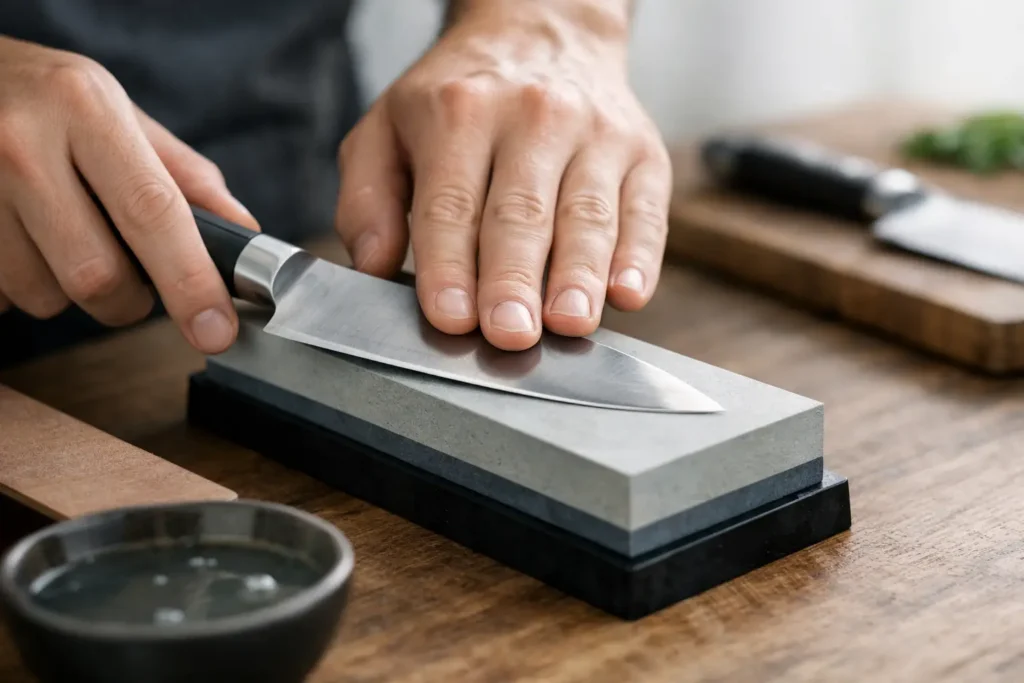
Place the knife on the stone at your chosen angle. Many people find it easiest to begin with the heel of the blade and work toward the tip. Using light to moderate pressure, sweep the knife across the stone as though you are trying to slice a thin layer off the surface. Cover the full edge as evenly as you can.
Some sharpeners prefer small sections, working heel, middle, and tip separately. Others use one smooth motion. Either can work. What matters is consistent contact, a stable angle, and even time on both sides.
After several passes, check for a burr. A burr is a tiny wire edge that forms on the opposite side of the blade as steel is removed. You can feel it carefully by moving your finger across the blade, never along the edge. Once you raise a burr along most or all of one side, switch and repeat on the other side.
This is where many people stop too early. If you do not fully apex the edge, the knife may feel a little better but will not stay sharp for long. A complete burr tells you that both sides of the edge have actually met.
Refine the edge on a finer stone
Once the edge is established, move to a finer grit stone. Use lighter pressure than before. Your job here is not heavy metal removal. It is smoothing the scratch pattern, reducing the burr, and leaving a cleaner cutting edge.
A few alternating passes per side often work well at this stage. If the knife is for general kitchen use, you do not need an ultra-polished edge. In fact, some cooks prefer a bit of bite for tomatoes, peppers, and herbs. The best finish depends on what the knife does most often.
After the fine stone, wipe the blade clean and test it on paper or a tomato. It should cut with less pressure and more control. That is the real benchmark. Sharpness is not about showing off. It is about easier, safer work.
Common mistakes when sharpening a good knife
The biggest mistake is rushing. Sharpening goes wrong when people push too hard, change angles constantly, or jump between tools without a clear method. A good knife does not need aggressive treatment.
Another common issue is overusing pull-through sharpeners. They seem convenient, and for low-cost knives that may be acceptable once in a while. But on a good blade, repeated use can chew away steel and shorten the life of the knife. Convenience has a trade-off.
There is also the temptation to sharpen too often. If the knife only needs a quick tune-up, honing may bring it back. Regular maintenance helps you avoid heavy sharpening sessions that remove more material than necessary.
And then there is the tip. Knife tips are easy to round off if you lift the handle too much or let the blade angle drift at the end of the stroke. Slow down there. The curve of the blade needs deliberate control.
When to hone and when to sharpen
If your knife sees frequent use, honing can be part of normal upkeep. A few light passes on a honing rod can realign the edge between sharpenings. This works best when the knife is not truly dull yet.
Sharpening is for the point when honing no longer helps. If the edge folds back into place for a meal or two and then feels tired again, it is probably time for stone work or professional sharpening. Home cooks may only need full sharpening every few months, while restaurant kitchens may need a much tighter schedule. It depends on the steel, the cutting surface, and how hard the knife works.
Wood and softer cutting boards are easier on edges than glass, stone, or very hard composite boards. Storage matters too. Tossing knives in a drawer can damage the edge no matter how carefully it was sharpened.
When professional sharpening makes more sense
Knowing how to sharpen a good knife is useful, but that does not mean every knife owner needs to do it personally. If you have high-end kitchen knives, inconsistent results at home, or simply do not want to spend time learning angles and burr formation, professional sharpening can be the smarter option.
That is especially true when the blade has chips, a broken tip, uneven bevels, or years of wear. At that point, sharpening is not just maintenance. It is edge correction. A trained sharpener can restore the profile, remove less material overall, and help the knife perform the way it was meant to.
For busy households and commercial kitchens, outsourcing also keeps tools ready without adding one more task to the week. That practical side matters. A sharp knife is only useful if it is available when you need it.
How to keep the edge longer
A well-sharpened knife lasts longer when the daily habits are right. Hand wash it instead of sending it through the dishwasher. Dry it right away. Use an appropriate cutting board. Store it where the edge will not knock into other tools.
Just as important, use the knife for the job it was designed to do. Twisting through hard materials, scraping the board with the edge, or using a chef’s knife like a pry bar will dull or damage it fast. Good knives hold up well, but they are still cutting tools, not general-purpose levers.
If you want the shortest version of all this, it is simple. Sharpen less often, but sharpen correctly. Maintain the edge before it gets terrible. And if the knife matters to you, treat sharpening as part of owning it, not as a last resort.
A good knife should make prep feel easier, cleaner, and more predictable. When the edge is right, you notice it in every slice – and once you get used to that, dull starts feeling unnecessary.