A prep cook should not have to press a tomato flat to slice it, and a line cook should not lose time sawing through herbs between tickets. That is where a practical commercial kitchen knife guide earns its place: not as a lesson in collecting expensive knives, but as a way to keep prep moving, protect staff, and reduce avoidable waste.
For restaurants, caterers, and other food-service teams, knives are working equipment. The best setup is the one that fits your menu, your staff’s habits, and the pace of your operation. A compact, well-maintained knife kit usually serves a kitchen better than a crowded rack of specialty blades nobody reaches for.
Start With the Knives Your Kitchen Uses Every Day
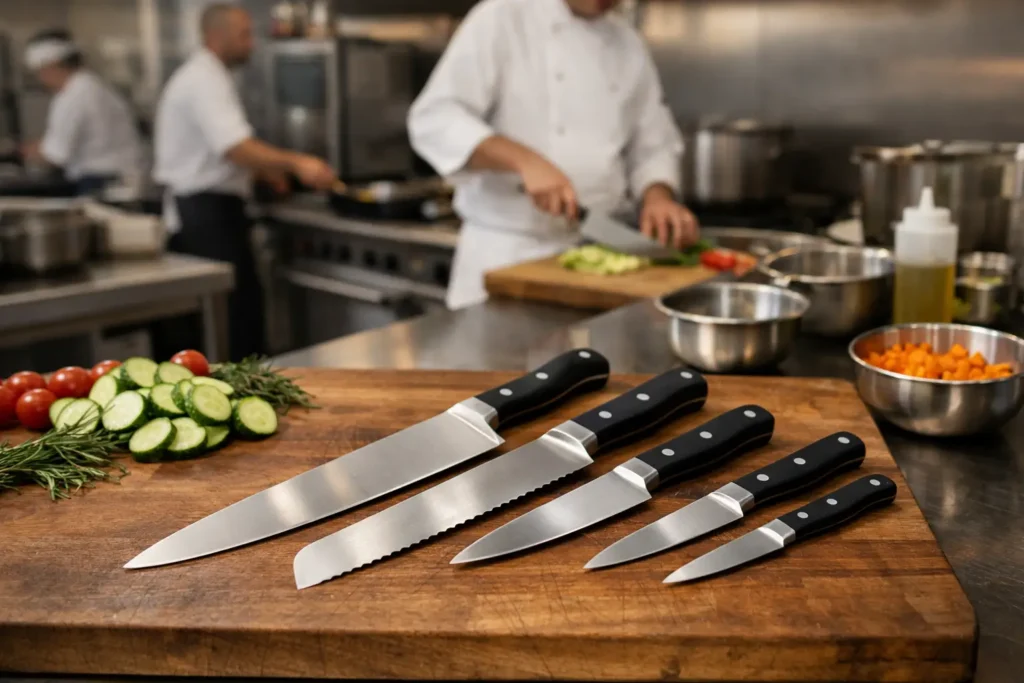
Most commercial kitchens can handle the majority of prep with a few dependable knife types. The chef’s knife is the general-purpose workhorse for chopping, slicing, and dicing. An 8-inch blade is common because it offers enough length for volume prep while remaining manageable for many cooks. Larger 10-inch chef’s knives can be useful when processing bigger produce or working through high-volume prep, but they are not automatically better for every hand or station.
A paring knife handles smaller, close-detail work such as trimming fruit, peeling, coring, and cleaning vegetables. It is easy to overlook because of its size, yet a dull paring knife creates just as much frustration as a dull chef’s knife. Keep enough in rotation that staff are not forced to use one for tasks it cannot safely handle.
A serrated bread knife belongs in any kitchen that slices bread, pastries, tomatoes, citrus, or delicate items with a firm exterior and soft center. Serrated edges do not need the same frequent sharpening schedule as straight edges, but they do eventually wear down and require proper service. Avoid treating them as permanently maintenance-free.
Depending on the menu, your team may also benefit from a boning knife for trimming proteins, a utility knife for mid-sized prep, or a slicer for carving cooked meats. The right additions depend on actual production. A steakhouse, bakery, sushi counter, and catering kitchen will not use the same knife mix, so buy and maintain for the work in front of you.
Commercial Kitchen Knife Guide: Choosing the Right Build
When selecting knives, focus first on balance, comfort, durability, and how readily the knife can be maintained. A knife that feels secure and natural in a cook’s hand is more likely to be used correctly. If the handle is too slick, too bulky, or uncomfortable after twenty minutes of prep, it is not the right choice for that station.
Stainless steel is popular in commercial kitchens because it resists corrosion and holds up well in wet, fast-moving environments. Different steel types vary in edge retention, toughness, and ease of sharpening. Harder steel may hold an edge longer, but it can be more prone to chipping if it is misused. Softer stainless may need more frequent touch-ups, yet it can be easier to restore and more forgiving during busy service.
There is also a practical trade-off between lightweight stamped knives and heavier forged knives. Stamped knives are often more affordable and can be excellent tools for high-turnover or high-volume environments. Forged knives may offer more balance and a sturdier feel. Neither category guarantees quality by itself. A well-made knife that fits the task and receives regular care is the better investment.
Handle material matters, too. Commercial kitchens generally benefit from handles that are durable, easy to clean, and comfortable when wet. Whatever style you choose, establish consistent handling expectations. Knives should never be left loose in a sink, stored where someone has to reach blindly for them, or passed handle-first without clear communication.
Sharp Is Safer, Faster, and Easier on Food
A dull knife is not a safe knife. When a blade cannot bite into food cleanly, the user adds pressure. More pressure means less control, and less control increases the chance of a slip. A sharp blade lets the cook make a deliberate cut with less force.
Sharp knives also improve the quality of the food leaving the prep table. Clean cuts bruise herbs less, leave onions and tomatoes more intact, and make consistent portioning easier. On proteins, a maintained edge helps create cleaner slices instead of tearing. Those small improvements can show up in presentation, yield, and speed over the course of a shift.
For a kitchen manager, the value is operational. Prep takes longer when cooks fight dull blades. Inconsistent cuts affect cook times and portions. Damaged knives get replaced sooner than necessary. Regular edge maintenance costs less than constantly buying replacement knives because the existing set has been neglected.
Honing and Sharpening Are Different Jobs
These terms are often used interchangeably, but they solve different problems. Honing realigns the fine edge of a knife that has bent slightly through normal use. It does not remove much metal, and it can help a knife feel sharper between professional sharpening appointments.
Sharpening removes a controlled amount of metal to create a new cutting edge. When a knife slips on a pepper skin, crushes herbs, or no longer responds to honing, it needs sharpening. Trying to hone a truly dull knife back to life only delays the real fix.
A honing rod can be useful in trained hands, but it is not a cure-all. Staff should understand proper angle and light pressure. Aggressive honing can damage an edge, particularly on thinner or harder blades. Pull-through sharpeners can be tempting because they seem quick, but many remove too much metal or leave a rough, uneven edge. In a commercial setting, consistency matters more than a rushed shortcut.
Build a Knife Maintenance Routine That Works During Service
The best maintenance schedule is one your staff can actually follow. Start by assigning responsibility for basic daily care. Knives should be hand-washed promptly, dried completely, and stored in a knife rack, sheath, magnetic holder, or other protected system. Dishwasher cycles, crowded sinks, and loose storage are common sources of dull edges, damaged tips, and workplace injuries.
Cutting boards matter as much as cleaning. Wood and quality plastic boards are generally kinder to knife edges than glass, ceramic, stone, or metal surfaces. A good knife can become frustratingly dull in a short time when it is used on the wrong board.
For sharpening, the exact frequency depends on volume, food type, steel, and staff habits. A high-volume prep kitchen may need a regular rotation every week or two. A lower-volume operation may go longer. Rather than relying only on the calendar, watch for performance signs: increased pressure, ragged cuts, slipping on smooth produce, or cooks reaching for a different knife because their usual one no longer performs.
A simple rotation system prevents disruptions. Keep enough knives in circulation so a batch can be serviced while the kitchen continues working with sharp replacements. Sharper Tools’ Knife Swap & Go service is built around that need, helping Seattle-area restaurants and caterers keep their knife supply moving without putting prep on hold.
Train for Use, Not Just Storage
Even great knives wear out quickly when used for the wrong jobs. A chef’s knife should not be used to pry apart frozen food, cut through bones, open containers, or scrape food off a board with the sharp edge. Turn the knife over and use the spine for scraping, or use a bench scraper instead.
Basic knife skills training should include stable cutting boards, proper grip, controlled cutting motions, and safe carrying. Staff also need permission to report a dull, chipped, bent, or damaged knife immediately. A damaged knife should leave service until it can be evaluated. Asking a cook to work around a bad edge is not a cost-saving measure.
For managers, consistency is the goal. Standardize the knives at each station where possible, label storage areas, and make it easy to tell which knives are due for service. When the system is clear, knife care stops depending on one especially organized employee.
Know When a Knife Needs Professional Attention
Some wear is obvious: chipped edges, broken tips, deep scratches, or blades that no longer cut cleanly. Other signs are quieter. If a knife rocks unevenly on a flat surface, has a bent tip, or feels thicker behind the edge than it used to, it may need more than a quick touch-up.
Professional sharpening is especially worthwhile for kitchen knives that see daily use, serrated knives, and blades with damaged edges. Proper service restores performance while respecting the knife’s shape and useful life. The goal is not simply to make a blade feel sharp for a day. It is to create an even, durable edge that supports the work your team does.
A reliable knife program does not need to be complicated. Choose practical knives, protect them from misuse, keep them clean and dry, and rotate them for sharpening before they become a problem. When every cook can reach for a sharp, dependable blade, the whole kitchen feels more prepared for the next ticket.