A tomato that squashes instead of slices is not just annoying. It is a warning that your knife is making kitchen work slower and less safe. The best knife sharpening methods depend on the knife, the condition of its edge, and how much time and practice you want to put into maintenance. For most Seattle-area households and busy kitchens, the right answer is usually a mix of regular honing and occasional professional sharpening.
What a Sharp Knife Actually Needs
Knife care is often reduced to one instruction: sharpen your knives. In practice, sharpening and honing solve different problems. Sharpening removes a small amount of metal to create a new cutting edge. Honing realigns the fine edge that bends slightly through normal use.
That distinction matters because a knife can feel dull even when it does not need a full sharpening. If it has started slipping on onion skin but still cuts reasonably well with pressure, honing may restore its performance. If it tears herbs, crushes tomatoes, or will not cleanly cut paper after honing, the edge likely needs sharpening.
A sharp knife also improves safety. Dull blades require more force, and extra force makes a slip more likely. Whether you are preparing dinner for four or handling prep for a restaurant service, a predictable edge makes every cut easier to control.
Best Knife Sharpening Methods Compared
There is no single method that suits every cook, knife, or schedule. Some approaches offer excellent control but take practice. Others are convenient but remove more metal than necessary. The best choice comes down to how much precision you need and how often you are willing to maintain the knife.
Whetstones: Best for Control and Edge Quality
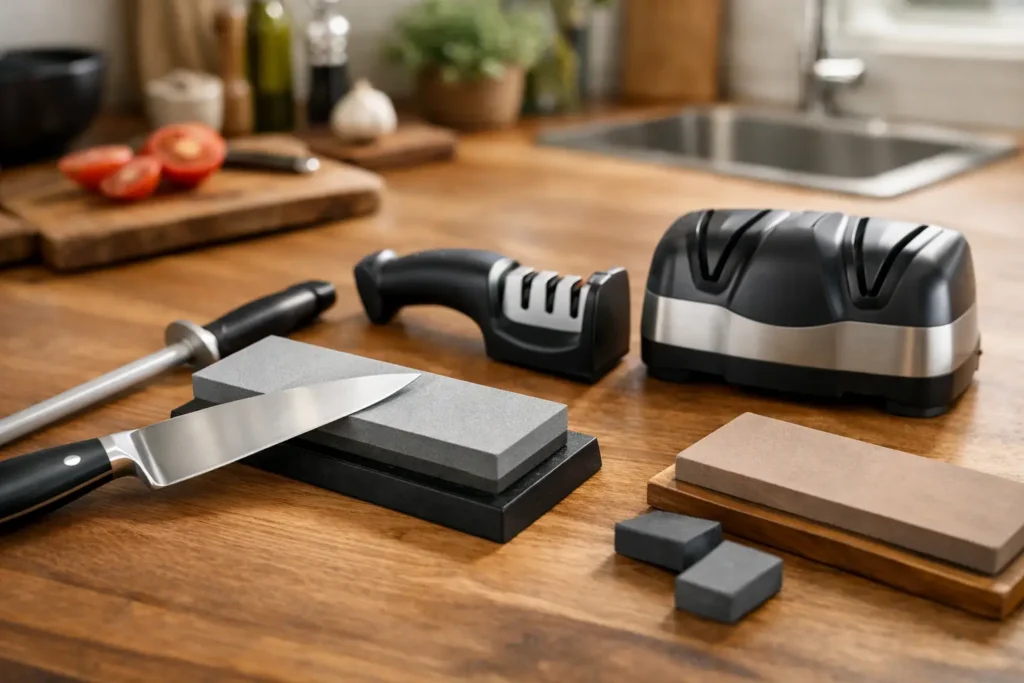
Whetstones, also called sharpening stones, are the traditional choice for people who want the most control over their knife edge. A stone uses an abrasive surface and a consistent sharpening angle to remove metal gradually. With proper technique, it can produce a very sharp, refined edge while preserving the shape of the blade.
The trade-off is the learning curve. Holding a steady angle from heel to tip takes practice, and inconsistent technique can create an uneven edge. Stones also need care of their own. Water stones may need soaking and flattening, while oil stones require a different setup.
For an enthusiastic home cook with a few quality knives, learning on a whetstone can be rewarding. It is less practical for someone who only wants dinner prep to go faster or for a restaurant team that cannot spare time for individual knife maintenance. A skilled professional can provide the benefits of a stone-sharpened edge without the trial-and-error period.
Manual Pull-Through Sharpeners: Best for Quick Convenience
Manual pull-through sharpeners are common because they are simple. You draw the blade through one or more slots, and the abrasive inserts reshape the edge. They can bring a very dull everyday knife back to usable condition in a few passes.
The downside is that many models remove metal aggressively and offer little control over the angle. Repeated use can wear down a blade faster than necessary, especially on thinner kitchen knives. They also may not follow the original edge geometry of higher-quality knives.
A pull-through sharpener can be a reasonable emergency tool for an inexpensive utility knife. It is not the best long-term method for knives you value, nor is it ideal for maintaining a consistent edge across a working kitchen’s knife set.
Electric Sharpeners: Best for Speed, With Limits
Electric sharpeners use motorized abrasive wheels to sharpen quickly. They are convenient for people who have several household knives and want a more consistent result than a basic manual sharpener can provide. Many models use staged slots, moving from coarser sharpening to a finer finishing step.
Speed comes with a cost. Like pull-through models, electric sharpeners can remove more metal than a careful hand process. Some also set a fixed angle that may not match your knife’s original edge. A quality unit used occasionally can be useful, but frequent use can shorten the useful life of a favorite blade.
For restaurant operators, electric sharpening is often not the best operational answer. It can be noisy, requires staff attention, and still does not replace the need for proper edge assessment. Consistency matters more than simply getting a knife sharp for the moment.
Honing Rods: Best for Regular Maintenance
A honing rod is not generally a sharpening tool, despite how it is often used. A steel or ceramic rod helps straighten and refresh an edge between sharpenings. Used correctly, it keeps a knife cutting well longer and reduces how often metal needs to be removed.
For most home kitchens, a few light passes on a honing rod before a cooking session can make a noticeable difference. The key word is light. Pressing hard does not improve the result and can damage the edge. Ceramic rods provide mild abrasive action, while smooth steel rods focus more on realignment.
Honing will not fix chips, a rounded edge, or a knife that has become truly dull. Think of it as routine upkeep, like checking tire pressure, rather than a full repair.
Professional Sharpening: Best for Valuable Knives and Reliable Results
Professional sharpening is the most dependable option when a knife is seriously dull, chipped, unevenly sharpened, or important to your daily work. A trained sharpener can assess the blade, choose an appropriate edge angle, remove only the metal needed, and restore a clean cutting edge.
This is especially useful for households with a mix of kitchen knives, outdoor tools, scissors, and garden equipment that all need attention at once. Instead of buying separate devices and learning several techniques, you can have the tools evaluated and serviced for their intended use.
For commercial kitchens, a dependable sharpening routine is an operations issue, not a luxury. Consistently sharp knives reduce prep time and help cooks work with more control. Sharper Tools LLC offers local knife service and a Knife Swap & Go option designed to keep restaurant and catering teams supplied with ready-to-use knives without interrupting the workday.
Choosing a Method for Your Knife Type
The knife itself should guide the decision. A sturdy Western-style chef’s knife can handle regular honing and occasional sharpening with several methods. A thinner or harder blade benefits from more careful angle control, which makes whetstones or professional service a better fit.
Serrated knives require special attention. Their teeth are not restored effectively by standard pull-through sharpeners or a flat stone. They need a process that addresses each serration while maintaining the blade’s pattern. Using the wrong tool may make the knife feel rougher without improving its cutting ability.
Knives with visible chips, bent tips, or badly uneven edges should also skip the quick-fix route. These issues need assessment before sharpening begins. Trying to force a damaged knife through a home sharpener can worsen the problem or remove more blade material than needed.
How Often Should You Sharpen Kitchen Knives?
Frequency depends on use, cutting surfaces, and storage. A home cook who prepares meals most nights may need professional sharpening once or twice a year, with regular honing in between. A knife used occasionally may go longer. A restaurant knife used through multiple prep shifts may need attention far more often.
Your cutting board makes a difference, too. Wood and quality plastic boards are easier on edges than glass, granite, ceramic plates, or countertops. Proper storage matters as well. Loose knives knocking together in a drawer lose their edge quickly and can create a safety hazard when you reach in.
A simple test is more useful than following a calendar. If your knife struggles to slice a ripe tomato, starts tearing fresh herbs, or requires excess pressure on an onion, it is time to hone or sharpen. Start with honing. If the result is still disappointing, schedule sharpening.
A Practical Maintenance Routine That Saves Blades
The most cost-effective method is not necessarily the sharpener that works fastest today. It is the routine that keeps your knives useful for years. Use an appropriate cutting board, wash and dry knives by hand when possible, store them so edges do not strike each other, and hone them lightly on a regular basis.
Then reserve full sharpening for when the edge truly needs it. This approach preserves blade material, keeps food prep more pleasant, and avoids the cycle of letting every knife become completely dull before taking action.
If your kitchen knives have reached the point where honing no longer helps, do not keep fighting them through another meal. A well-timed professional sharpening can turn familiar tools back into the dependable tools you bought them to be.