The first sign of trouble in a busy kitchen usually is not dramatic. It is the tomato skin that will not break cleanly, the herbs that bruise instead of slice, or the prep cook pressing harder than they should. Commercial kitchen knife maintenance matters because those small slowdowns stack up fast. They affect speed, consistency, safety, and the working life of the knives your team depends on every shift.
For restaurants, caterers, and commissary kitchens, knife care is not about keeping gear looking nice. It is part of smooth service. A well-maintained knife cuts with less force, gives cleaner portions, and helps staff stay efficient during repetitive prep. A neglected knife does the opposite. It drags, slips, tires out the user, and often ends up damaged long before it should.
Why commercial kitchen knife maintenance affects more than the blade
A dull knife slows prep in ways that are easy to miss until the whole station starts falling behind. Line cooks compensate by sawing more, applying extra pressure, or switching tools mid-task. That can reduce yield on proteins, crush delicate produce, and create uneven cuts that affect cook times and presentation.
There is also the safety side. Many people assume a sharper knife is more dangerous, but in professional kitchens the opposite is usually true. Sharp knives are more predictable. They bite where they are placed and require less force to move through product. Dull edges are more likely to skid or twist, especially on slick items like onions, peppers, and fish.
Good maintenance also protects your investment. Commercial knives are built to work hard, but they are not disposable. Replacing chipped or badly worn knives costs more than keeping a regular maintenance routine. For operations watching food cost, labor, and equipment spend all at once, that routine pays for itself in fewer interruptions and longer tool life.
The core habits that keep knives working
Commercial kitchen knife maintenance starts with what happens between sharpening appointments. The biggest gains usually come from a few consistent habits rather than anything complicated.
Cleaning is the first one. Knives should be washed by hand, dried right away, and put back in the right place. Leaving them in a sink, soaking in bus tubs, or banging around with other tools is a fast way to damage the edge. Even stainless steel blades can stain, pit, or develop edge issues when they stay wet or contact harsh residues for too long.
Storage matters just as much. Tossing knives into a drawer may be common at home, but in a commercial setting it shortens edge life and creates unnecessary risk. Knife racks, guards, rolls, and designated slots all help. The best storage option depends on your workflow, but the goal is always the same – protect the edge and make the knife easy to retrieve safely.
Cutting surface is another hidden factor. A quality knife used on the wrong board will dull much faster. Wood and certain food-safe plastic boards are generally edge-friendly. Hard surfaces like glass, stone, or metal are rough on edges and should stay out of the prep rotation.
Then there is basic handling. Scraping chopped product off the board with the cutting edge, twisting through hard items, or using a chef knife like a pry tool will wear it down quickly. In busy kitchens, these habits creep in when people are rushing. That is why maintenance is partly about training, not just equipment.
Honing vs. sharpening in a commercial kitchen
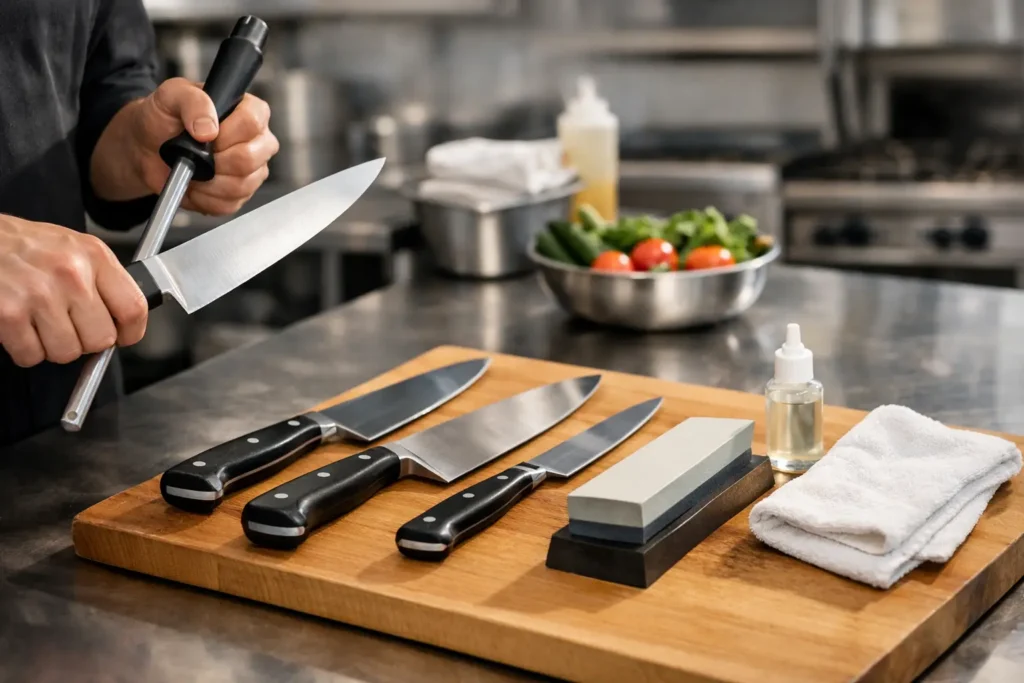
These two get mixed up all the time, and the difference matters. Honing realigns the edge. Sharpening removes material to create a fresh edge. If your team uses a honing rod regularly, that can help knives stay serviceable between sharpenings, but it does not replace sharpening.
Honing works best on knives that are slightly rolled from normal use, not knives that are truly dull or chipped. If a blade still struggles after proper honing, it likely needs professional sharpening. Pushing a worn-out edge through another week of prep often creates more frustration and more damage.
There is also an it depends factor here. Not every knife in a commercial kitchen should be honed the same way or at the same frequency. Softer stainless workhorses often respond well to regular honing. Harder steels may need a lighter touch and more careful technique. If staff are using rods aggressively or incorrectly, they can do more harm than good.
How often should restaurant knives be sharpened?
There is no single schedule that fits every kitchen. A high-volume restaurant doing heavy prep all day will need more frequent service than a smaller operation with a limited menu. The type of ingredients matters too. Breaking down squash, root vegetables, and large proteins wears edges faster than lighter garnish work.
For many commercial kitchens, the right answer is routine sharpening before performance drops badly. Waiting until knives are obviously dull is where costs start to rise. Prep slows down, staff work harder, and edges may need more correction than they would have with regular care.
A practical schedule often comes down to consistency. Some kitchens benefit from weekly service. Others do well biweekly or monthly, depending on volume and the number of knives in circulation. What matters is having a system that matches real use, not guessing based on calendar alone.
That is one reason exchange-style programs can work well for restaurants. Instead of pulling dull knives out of service and hoping someone remembers to get them sharpened, the kitchen gets a dependable rotation. For operations where every minute counts, that kind of setup keeps prep moving without adding one more task to the day.
Signs your knife routine needs work
Most kitchens do not need a full overhaul. They just need to spot the warning signs sooner. If knives are crushing herbs, tearing onions, slipping on tomato skins, or leaving staff with sore hands after normal prep, maintenance is already overdue.
You might also notice more subtle clues. Team members start reaching for the same one or two knives because the rest feel off. Portion cuts get less consistent. Someone starts using extra downward force to get through routine tasks. None of that is normal wear you should just accept.
Edge damage is another sign. Small chips, bent tips, and uneven bevels often come from storage problems or misuse, not just heavy volume. When those issues keep showing up, sharpening alone will not solve the root cause. The kitchen needs better handling habits to go with service.
Building a simple commercial kitchen knife maintenance system
The best systems are easy enough to follow on a busy Friday. Start with responsibility. Decide who checks knife condition, who handles storage, and who communicates when service is needed. If everyone assumes someone else is managing it, nobody is.
Next, look at where edge damage actually happens. It is often the sink area, the dish pit, or the crowded prep station where knives get stacked with other tools. A few changes in workflow can extend edge life more than people expect.
It also helps to separate daily care from periodic service. Daily care is hand washing, drying, proper storage, correct board use, and light honing when appropriate. Periodic service is professional sharpening based on your kitchen’s volume and knife mix. When those two parts work together, knives stay dependable instead of cycling between too dull and freshly sharpened.
For Seattle-area restaurants and caterers, convenience matters just as much as technique. If knife care depends on someone making a special trip across town, it tends to slip. A local service with pickup, drop-off, or a structured commercial program is often the difference between a plan that sounds good and one that actually happens.
When professional sharpening is the better call
There is a reason many commercial kitchens outsource this work. Professional sharpening saves time, delivers consistency, and helps avoid the edge damage that comes from rushed in-house attempts. That matters most when the knife set includes a mix of blade shapes, steels, and wear levels.
A professional can also catch issues early – chips, warped tips, over-honed edges, and knives that are simply being used for the wrong jobs. That kind of feedback is useful because it turns maintenance from a reactive expense into part of smoother kitchen operations.
For businesses that cannot afford prep delays, regular service is less about the knife itself and more about keeping the whole kitchen moving. Sharp tools support speed, accuracy, and safer work. They make a long prep list feel manageable instead of punishing.
A good knife should feel ready the moment it hits the board. Keep the routine simple, keep it consistent, and your kitchen will feel the difference every single shift.