A knife that has gone dull is not automatically a bad knife. In fact, the best kitchen knives for sharpening are often the ones you already own – provided they have sound steel, a solid blade shape, and no major damage. A knife designed to be maintained can serve a home kitchen or restaurant prep station for years, cutting more safely and making everyday work noticeably easier.
The goal is not to find a knife that never needs attention. Every working edge eventually wears down. The better goal is to choose knives that respond well to sharpening, hold an edge long enough for the way you cook, and can be restored without becoming thin, brittle, or misshapen.
What Makes the Best Kitchen Knives for Sharpening?
Sharpenability starts with steel. Kitchen knife steel needs to be hard enough to hold a clean edge but not so hard or brittle that routine use leads to chips. Many dependable Western-style chef’s knives use stainless steel in a moderate hardness range. They may not hold an edge as long as some premium Japanese blades, but they are generally forgiving to sharpen and well suited to busy households.
Harder Japanese-style steels can take an exceptionally fine edge and stay sharp for a long time. That can be a good fit for careful cooks who use a proper cutting board and do not twist, pry, or cut through bones with the blade. The trade-off is that a very hard, thin edge can chip if it is used roughly. Chip repair also removes more material than normal sharpening.
Blade geometry matters just as much as the steel. A knife with enough blade height and thickness behind the edge gives a sharpener room to restore it over time. Extremely thin blades can be wonderful for slicing vegetables and boneless proteins, but they need more deliberate care. A heavily worn knife that has been sharpened at a steep angle over and over may need thinning behind the edge before it cuts smoothly again.
A straight, gently curved cutting edge is the simplest to maintain. That is why a standard chef’s knife, santoku, petty knife, or paring knife is usually a better long-term sharpening candidate than a deeply serrated or unusually shaped blade.
Start With a Dependable Chef’s Knife
For most home cooks, the most useful knife to buy well and maintain is an 8-inch chef’s knife. It handles onions, herbs, vegetables, fruit, boneless meat, and most prep tasks without requiring a separate specialty tool for every job. Its broad blade and familiar curve also make it straightforward to sharpen properly.
A 6-inch chef’s knife can be a smarter choice for someone with limited counter space, smaller hands, or lighter prep needs. It has less reach for large squash, melons, and bulk chopping, but it is easier to control for many people. Either size can be an excellent choice if the handle feels secure and the knife is balanced in your hand.
Look for a blade that is not excessively thick at the edge. A knife can be sharp on paper yet still wedge through carrots and potatoes if there is too much metal behind that edge. A well-maintained chef’s knife should move through food with modest pressure rather than splitting it apart.
Add Small Knives You Will Actually Use
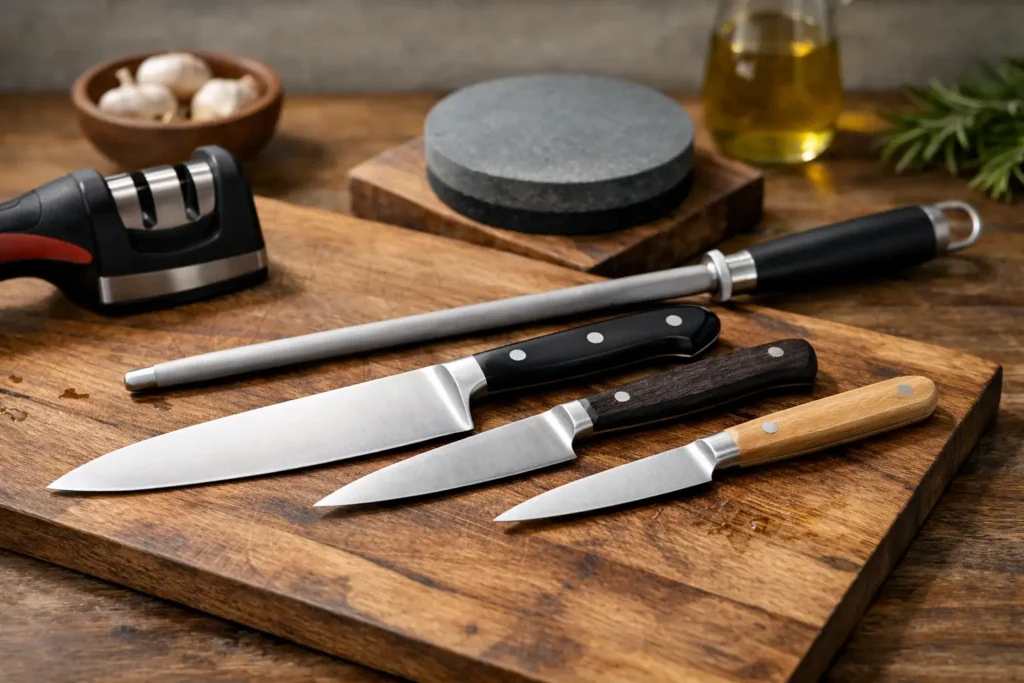
A chef’s knife does most of the work, but two smaller knives make a practical set easier to maintain. A 3- to 4-inch paring knife is useful for peeling, trimming, and detail work done away from the cutting board. A 5- to 6-inch utility or petty knife is ideal when a chef’s knife feels oversized for citrus, sandwiches, shallots, or a small portion of fish.
These smaller blades are typically easy to sharpen because their edges are short and straight. The caution is that narrow knives can lose their original shape quickly if they are sharpened aggressively. A quick, light service at the right time preserves more blade life than waiting until the knife is completely blunt.
If you regularly break down poultry or trim meat, a quality boning knife can also earn its place. Choose the flexibility that matches your work: a flexible blade follows bones and skin closely, while a stiffer one gives more control on firm cuts. Because the blade is narrow, consistent sharpening angles matter more than brute force.
Forged vs. Stamped: The Useful Difference
Forged knives are formed from a thicker piece of steel and are often associated with weight, balance, and a bolster near the handle. Stamped knives are cut from a sheet of steel and can be lighter and less expensive. Neither construction method alone determines whether a knife will sharpen well.
A well-made stamped knife with good heat treatment can be an excellent daily tool, especially for home cooks who prefer a lighter feel. A forged knife may be more comfortable for long prep sessions and may have more material available for years of reshaping. What matters most is the quality of the steel, the grind of the blade, and whether the knife is used for appropriate tasks.
Do not assume that a full tang guarantees a better edge, either. A full tang can add strength and balance to the handle, but sharpening happens at the blade. Choose a handle that does not shift in your grip and a blade that feels stable without being tiring.
Knives That Need More Careful Expectations
Serrated bread knives are valuable, particularly for crusty loaves and ripe tomatoes, but they are not the easiest knives to maintain. Their individual teeth require specialized work, and many general-purpose sharpeners cannot restore them correctly. Buy a good serrated knife when you need one, but do not expect the same quick service schedule as a plain-edge chef’s knife.
Very inexpensive knife sets can also be a mixed bag. Some use soft steel that becomes dull quickly but sharpens easily. Others have inconsistent grinds, thick edges, or handles that loosen long before the blade has earned a second life. There is nothing wrong with an affordable knife that feels good and cuts well, but a smaller set of dependable knives is usually a better value than a large block full of seldom-used pieces.
Damaged knives deserve an honest assessment. A few small chips, a rounded tip, or a misshapen heel can often be repaired. Deep corrosion, cracks, severely bent blades, or loose handles may make repair less practical. A professional can tell you what is worth restoring before unnecessary material is removed.
Keep the Edge Longer Between Sharpenings
Sharpening removes a small amount of metal to create a new edge. Honing realigns a slightly rolled edge without doing the same level of metal removal. Both have a place, but neither can compensate for poor cutting habits.
Use wood or quality plastic cutting boards, not glass, stone, ceramic plates, or bare countertops. Hand-wash knives and dry them promptly instead of letting them rattle through a dishwasher cycle. Store them in a blade guard, drawer insert, magnetic strip, or block that protects the edge from other metal utensils.
A few habits make a major difference:
- Use the right knife for the task. Do not use a chef’s knife to pry apart frozen food, open packages, or chop through hard bones.
- Cut straight down and forward or back. Avoid twisting the blade while it is buried in food.
- Hone a regularly used knife lightly when it starts to feel less precise, rather than waiting for it to slide across a tomato.
- Have the knife sharpened when honing no longer restores a clean, confident cut.
For a busy household, that may mean professional sharpening a few times a year. A restaurant may need a more frequent schedule because prep volume is much higher. The right interval depends on use, steel, cutting surface, and how carefully the knives are handled.
Choose Service That Preserves the Knife
The best sharpening is not simply the fastest way to make a blade feel sharp. It should restore a clean edge while respecting the knife’s intended angle, blade shape, and remaining life. Too much aggressive grinding can shorten a knife’s useful life, change the tip profile, and leave the blade thick behind the edge.
Bring up specific concerns when you drop off a knife: chips, a broken tip, a blade that steers to one side, or a handle that feels loose. Those details help determine whether the knife needs basic sharpening, repair work, or a different approach. For commercial kitchens, a consistent service plan also prevents the scramble of discovering every prep knife is dull during a shift.
Seattle-area cooks and food businesses do not need to replace a trusted knife just because it has lost its bite. Sharper Tools can help keep everyday kitchen knives working as they should, with convenient service for people who would rather spend their time cooking than fighting a dull blade.
A good kitchen knife should feel like a reliable tool, not a disposable purchase. Choose one that fits your hand and your cooking, use it with care, and sharpen it before dullness turns ordinary prep into hard work.