You usually notice a dull knife at the worst possible moment – halfway through dinner prep, during a busy prep shift, or when a simple task starts taking twice as long. That is where the choice between mobile knife sharpening versus shop service becomes practical, not theoretical. The best option depends on how you use your tools, how quickly you need them back, and whether convenience or specialized turnaround matters more.
Mobile knife sharpening versus shop service: what changes for you?
At a basic level, both services aim to do the same thing: restore a clean, usable edge and help your tools last longer. The difference is how the service fits into your day.
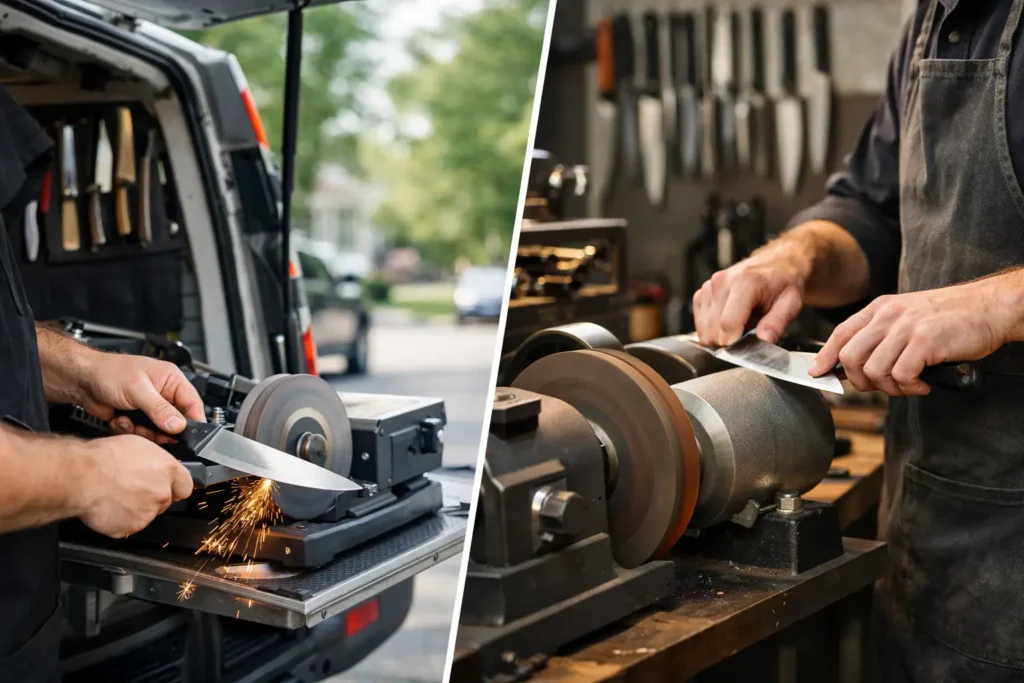
Mobile knife sharpening brings the service closer to you. In some cases that means on-site work. In others, it can mean pickup and return built around your schedule. For homeowners, that often removes the hassle of planning a separate errand. For busy kitchens or small businesses, it can reduce downtime and keep operations moving.
Shop service, on the other hand, happens at a dedicated sharpening location. That setting can be a strong fit when a tool needs more involved work, when several items are being handled together, or when the provider uses bench equipment and inspection steps that are easier to manage in a fixed workspace. If your knife has chips, a damaged tip, or years of uneven wear, a shop setting may offer more room for careful correction.
Neither option is automatically better. The real question is what kind of problem you are trying to solve.
When mobile service makes the most sense
If your biggest obstacle is time, mobile service often wins. A lot of people put off sharpening because the knife still kind of works, and dropping it off somewhere feels like one more stop in an already full week. When sharpening comes to your home, workplace, or neighborhood, it becomes much easier to stay on top of regular maintenance.
That matters more than people expect. Knives that are sharpened before they get badly worn are usually easier to maintain. You spend less money on major edge repair, and the knife generally stays more predictable in use. For home cooks, that means less slipping on tomatoes, onions, and herbs. For restaurant staff, it means faster prep and less fatigue over the course of a shift.
Mobile service can also be a good fit when you have more than knives. If you are gathering kitchen knives, scissors, garden tools, or mower blades, convenience starts to carry real value. Instead of making multiple trips or letting dull tools pile up in the garage or drawer, you handle the problem in one move.
There is also the local factor. In a busy area like Seattle, convenience is not a luxury. Traffic, scheduling, and parking all affect whether a task gets done this week or next month. A service model built around pickup, drop-off, or route-based convenience often fits real life better than a traditional errand.
When shop service is the better choice
Shop service tends to shine when the edge issue is more than routine dullness. If a knife has visible damage, an uneven bevel, a broken point, or a blade shape that has drifted over time, working in a dedicated shop can make a difference. The sharpener has access to a full setup, better lighting, a controlled workspace, and more flexibility to spend time on correction work.
That can be especially helpful for customers who want the blade profile evaluated, not just sharpened. A knife can feel dull for reasons beyond the final edge. It may be too thick behind the edge, worn unevenly, or previously sharpened at a poor angle. A shop environment can make those underlying issues easier to address.
Shop service can also be a strong option for people who are already passing by the location as part of their routine. If drop-off and pickup are simple for you, and you do not mind waiting a bit longer for completion, a shop visit may be perfectly sensible.
For some customers, there is also peace of mind in seeing a dedicated sharpening space. It reinforces that this is not a side service squeezed into another business. It is focused tool care.
Edge quality: is one sharper than the other?
This is where people often expect a simple answer, but it depends on the provider more than the format. A skilled sharpener can produce excellent results through either mobile service or shop service. Good sharpening comes from judgment, consistency, and tool knowledge, not just location.
That said, service format can affect what is realistic. Routine sharpening is often straightforward enough to handle well in a mobile setup or through organized pickup and return. More extensive repairs may benefit from the space and equipment of a shop. So if your knives just need maintenance, mobile service may give you the same practical result with less effort on your part. If they need reshaping or repair, shop service may offer more flexibility.
For commercial customers, consistency matters as much as raw sharpness. A restaurant does not just need one knife to feel sharp today. It needs a repeatable service that keeps the whole kit working safely and predictably. That is why some kitchens prefer a structured local program over occasional one-off sharpening.
Cost, downtime, and the hidden value of convenience
People often compare sharpening options by price alone, but that misses part of the picture. If a lower-cost service requires extra driving, awkward scheduling, or several days without tools you rely on, the real cost goes up.
For a homeowner, the difference may be small but still meaningful. A mobile or pickup-based option can save an afternoon and make it far more likely that sharpening actually gets done. For a business, downtime can be expensive fast. If prep slows down, staff compensate with more force, or backup knives are in poor condition too, the impact spreads well beyond the sharpening invoice.
That is why convenience is not fluff. It is part of the service value. A practical sharpening service should reduce friction, not add to it.
At the same time, there are cases where shop service is worth the extra step. If the tool is valuable, damaged, or unusual, a more hands-on process may justify a longer turnaround. The smart choice is the one that matches the condition of the tool and the pace of your work.
Mobile knife sharpening versus shop service for home and commercial users
Home users usually care most about ease, trust, and getting everyday tools back in working shape without hassle. If that sounds like you, mobile service or convenient local pickup may be the best fit. It keeps your kitchen, garden, and household tools in use without asking you to build a day around maintenance.
Commercial users often need a more structured answer. A restaurant or catering operation cannot afford inconsistent edges or missing knives in the middle of service. In that case, the best solution may be the one built around predictable rotation, reliable turnaround, and minimal disruption. Sharper Tools LLC, for example, serves Seattle-area commercial kitchens with practical service options designed around workflow, not guesswork.
That is the bigger point here. The right sharpening service should fit how you actually live or work. If you are juggling family meals, yard work, and a full schedule, convenience matters. If you are running a kitchen, consistency and uptime matter even more.
How to decide without overthinking it
Start with three questions. First, are your knives simply dull, or are they damaged? Second, how much downtime can you tolerate? Third, is getting the tools to a shop easy for you, or is that exactly the step that keeps getting postponed?
If the blades are in decent shape and you mainly want fast, convenient maintenance, mobile sharpening or a pickup-and-drop-off model is often the most practical call. If the edges are chipped, misshapen, or long overdue for serious correction, shop service may be the smarter route.
A good local provider should also be honest about that distinction. Not every knife needs intensive work, and not every job belongs in a fully equipped shop. The best service is the one that meets the need without wasting your time or overselling the fix.
Sharp tools make ordinary work easier. Whether that means sending them to a shop or choosing a mobile option, the right decision is the one that gets your tools back into your hands, ready to do their job well.