A tomato should not collapse under your chef’s knife. If it does, the problem may not be what you think. In the knife honing vs sharpening conversation, people often use the terms interchangeably, then wonder why a few passes on a steel do not bring back a knife that has been dull for months. Both services matter, but they solve different problems at the edge.
For home cooks, that difference means faster prep, cleaner cuts, and fewer slips. For a restaurant or catering kitchen, it can mean keeping service moving without asking cooks to work around tired, unpredictable knives. Knowing which kind of care your knife needs helps you get more life from a good tool and avoid wasting time on the wrong fix.
Knife Honing vs Sharpening: The Simple Difference
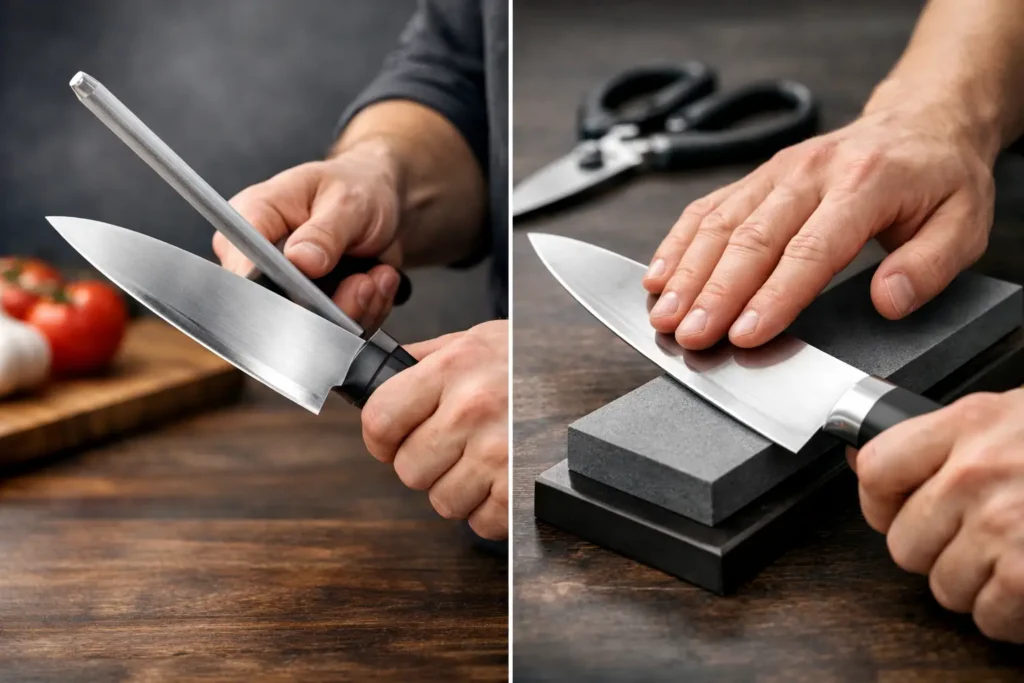
Honing realigns an edge. Sharpening removes a small amount of metal to create a new, keen edge.
A knife edge is extremely thin. With normal use, that fine edge can bend slightly to one side or develop tiny irregularities. The knife may still have plenty of usable steel at the edge, but it no longer meets food cleanly. A honing rod, especially a smooth steel or ceramic rod, helps straighten and refine that slightly rolled edge.
Sharpening is what the knife needs after the edge has worn down, chipped, or become rounded. A professional sharpener uses abrasives and controlled angles to restore the bevel and bring back cutting ability. This is maintenance, not a failure. Every working knife eventually needs it.
Think of honing as straightening the edge that is already there. Think of sharpening as rebuilding the edge when straightening is no longer enough.
What Honing Can and Cannot Do
Honing is useful between sharpenings, particularly for knives used often. A home cook who reaches for the same chef’s knife every day may benefit from a few careful honing passes before a larger prep session. In a commercial kitchen, regular honing can help staff maintain a consistent feel during service.
The key word is careful. Honing is not about aggressively scraping a knife down a rod as fast as possible. That dramatic motion may look familiar, but it is hard to control and can be unsafe. Keep the rod stable, use light pressure, and match the knife’s existing edge angle as closely as possible. A few passes per side are generally enough.
Honing will not repair a truly dull knife. It also cannot remove chips, correct a damaged tip, or restore an edge that has been ground away through years of use. If your knife still struggles after proper honing, the issue is probably sharpness, not alignment.
A common mistake is using a coarse grooved steel too often. Those rods can be useful in the right commercial setting, but they can also be more aggressive than many home knives need. For many kitchen knives, a smooth honing steel or fine ceramic rod is a gentler choice. The right tool depends on the knife, how it is used, and the condition of its edge.
Signs Your Knife Needs Sharpening
A sharp knife should start a cut with light pressure and travel through food predictably. It does not need force to get through an onion skin, bell pepper, or herb stems. When that changes, sharpening may be due.
The paper test is a quick check. Hold a sheet of printer paper and try slicing from the edge. A sharp knife should cut cleanly without tearing or snagging. This test is helpful, but your daily prep is often the better indicator. If you are sawing through tomatoes, crushing delicate herbs, or pressing hard enough that the blade feels likely to slip, stop relying on honing alone.
Visible chips, flat spots along the cutting edge, and a bent or broken tip are also clear reasons to seek professional sharpening. Do not try to force a damaged knife through food. Aside from poor results, extra force raises the chance of a hand injury.
There is no universal sharpening schedule. A knife used twice a day on a wooden cutting board will need attention sooner than one used only on weekends. Board material matters too. Glass, ceramic, stone, and other very hard surfaces can dull an edge quickly. A busy restaurant knife may need frequent professional rotation, while a household knife may need sharpening once or twice a year. It depends on the knife, the cutting surface, and the workload.
Why a Sharp Knife Is Often the Safer Knife
A dull knife is not harmless. It requires more downward pressure, which gives you less control when the blade finally breaks through food. That is when it can slide off a rounded onion, squash a tomato, or jump toward your fingers.
A properly sharpened knife bites where you place it. It gives you a cleaner start and a more predictable path through the ingredient. That matters for a quick weeknight dinner, but it matters even more when you are prepping cases of produce or working through a long catering list.
Sharpness also improves the food itself. Clean cuts help herbs stay brighter, onions release less juice during chopping, and vegetables hold their shape better. You do not need a specialty collection of expensive knives to get those benefits. A well-maintained everyday knife can be a dependable kitchen tool for years.
Get More Time Between Sharpenings
Good knife habits reduce unnecessary wear without turning kitchen care into a project. Use a wood or quality plastic cutting board instead of glass, ceramic, or a countertop. Hand-wash kitchen knives rather than running them through the dishwasher, where heat, detergent, and contact with other items can damage the edge.
Storage matters as well. Tossing knives into a drawer lets the edges knock against other utensils. A knife block, magnetic strip, blade guard, or organized drawer insert helps protect them. When carrying a knife, keep the blade pointed down and away from people, and never leave it hidden in a sink.
Use the knife for its intended job. Do not twist it through frozen food, pry open containers, cut on plates, or use the edge to scrape food from a board. Turn the knife over and use the spine for scraping instead. Small habits like these protect the edge and make professional sharpening more straightforward when the time comes.
When Professional Sharpening Makes Sense
At-home sharpeners can be convenient, but they come with trade-offs. Pull-through devices are quick, yet some remove more metal than necessary or use an angle that does not suit your knife. Stones can produce excellent results, but they take practice, patience, and consistency. An uneven angle can leave a knife sharp in spots and dull in others.
Professional sharpening is especially worthwhile for quality kitchen knives, damaged edges, and knives that have not been serviced in a long time. A trained sharpener can assess the blade, remove damage only as needed, establish a consistent edge, and return it ready for work. That preserves more useful life than repeatedly attacking a tired knife with a harsh gadget.
For Seattle-area households, pickup and drop-off service can take the errand out of edge care. For restaurants and caterers, a knife exchange program such as Sharper Tools’ Knife Swap & Go keeps dependable knives available without disrupting prep and service. The goal is simple: your team should have tools that work when the work needs to happen.
A Practical Routine for Home and Commercial Kitchens
Hone a knife lightly when it feels slightly less precise but still cuts reasonably well. Schedule sharpening when honing no longer restores clean, easy cuts. If you manage a kitchen with several staff members, build edge checks into the routine rather than waiting for complaints or accidents. Consistent rotation is easier than dealing with a full set of neglected knives at once.
After sharpening, give the new edge the respect it deserves. Use a suitable board, wash and dry the knife promptly, store it safely, and avoid using it for tasks outside food prep. You will notice the difference every time a blade glides through an onion instead of fighting it.
The next time a knife feels slow, do not guess. Check whether the edge simply needs alignment or whether it needs to be restored. A few right habits and timely professional care can keep the knives you already own safe, useful, and ready for the next meal.