
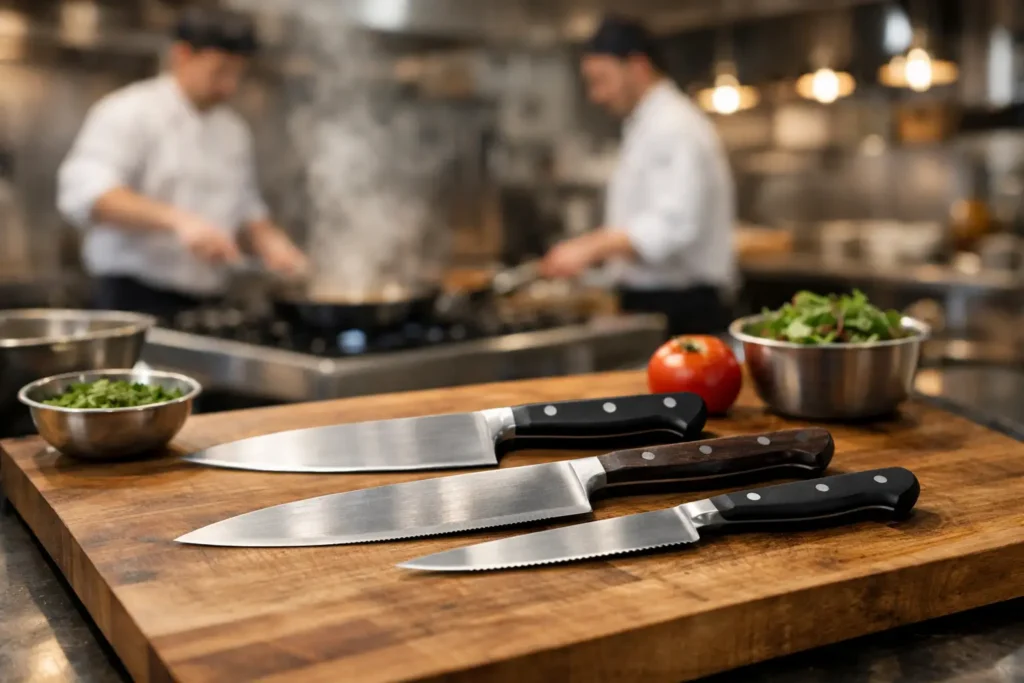
The prep cook noticed the problem halfway through a case of onions: the chef’s knife was slipping instead of slicing cleanly. A quick touch-up at the station got the job done, but it also slowed the whole prep list. This restaurant knife rotation case study follows a Seattle-area full-service kitchen that replaced last-minute sharpening and inconsistent knives with a scheduled rotation system.
The operation in this example is representative rather than a claim about one specific restaurant. Its challenges are common in busy kitchens: different cooks bringing in personal knives, house knives disappearing into dish, dull blades being tolerated too long, and no easy time to pull a knife out of service. The goal was simple – keep reliable sharp knives on every station without creating another task for the chef.
Restaurant Knife Rotation Case Study: The Starting Point
The restaurant served lunch and dinner six days a week, with a compact back-of-house team handling high volumes of vegetables, proteins, herbs, and garnish work. It had enough knives on paper. In practice, it never had enough sharp ones when prep was at its busiest.
Before the rotation program, knives were sharpened only when someone complained. That often meant a cook would hand over a blade during a shift, the chef would make a note to deal with it later, and the knife would continue in use for another day or two. A few team members used pull-through sharpeners or honing steels aggressively, which created inconsistent edges and shortened the time between professional service.
The cost was not limited to a dull blade. Prep took longer, tomato slices looked rough, herbs bruised more easily, and staff used extra force on dense produce and proteins. That force matters. A sharp knife is easier to control because it cuts with less pressure. When a knife skids or requires a hard push, the chance of an awkward cut goes up.
The chef estimated that the team lost small amounts of time throughout every shift rather than in one obvious block. That made the problem easy to ignore. But five minutes spent fighting a dull knife at each station can become a serious operational drag over a week.
Building a Rotation That Fit the Kitchen
The kitchen did not need a complicated inventory system. It needed a dependable routine that could survive a Friday dinner rush, staff changes, and the usual surprises of restaurant work.
The first step was separating the working knives from the knives waiting for service. The chef and kitchen manager counted the knives used daily, identified which styles each station actually needed, and set aside a small reserve. The reserve was the key. Without it, any knife sent out for sharpening created a gap on the line.
For this kitchen, the working set included chef’s knives, paring knives, utility knives, and a few specialty prep blades. The exact number will depend on menu volume, staffing, and whether cooks use personal knives, but the principle stays the same: have enough matching backup knives to replace a full batch without changing the way people work.
The restaurant then adopted four simple operating rules:
- Knives moved through service on a calendar, not only when they felt dull.
- Each station received a consistent type and quantity of knives.
- Damaged, bent, or heavily worn knives were separated from normal rotation.
- One person checked the outgoing and incoming sets before they reached the kitchen.
The kitchen chose a weekly exchange at first. That schedule made sense because produce prep was heavy and the restaurant was still correcting the backlog of neglected edges. Once the knives were in better condition, the manager could decide whether weekly service remained worthwhile or whether a longer interval would fit the actual workload.
This is where a local knife exchange service can make a practical difference. With Sharper Tools’ Knife Swap & Go service, the kitchen can exchange its scheduled set rather than wait for its own knives to be serviced one at a time. The benefit is continuity: cooks keep working with sharp, familiar tools while the outgoing set is handled off the clock.
What Changed During the First Month
The most noticeable improvement was not dramatic at first. It was quieter. Cooks stopped asking around for the one knife that still cut well. The opening prep crew spent less time testing blades on a tomato or tearing through herbs. The chef no longer had to decide whether a knife was dull enough to remove from service in the middle of a rush.
By the end of the first month, the kitchen manager reported fewer interruptions during prep and more predictable knife availability at every station. The restaurant also had a clearer picture of what was happening to its tools. Knives with chipped tips, loose handles, or damaged edges were identified early instead of being passed from cook to cook.
The biggest operational result was consistency. A rotation program does not mean every blade stays razor sharp forever. It means the kitchen has a plan before performance drops far enough to affect food quality, speed, or safety.
There was also a training benefit. Because knives arrived in a known condition, the chef could show newer cooks what a properly sharpened edge should feel like. That made it easier to spot misuse. A knife should be washed carefully, dried promptly, stored so the edge is protected, and used on an appropriate cutting surface. It should not be used to pry, scrape hard surfaces, or cut through tasks meant for another tool.
The Trade-Offs the Restaurant Had to Manage
Knife rotation is not a magic fix for every edge problem. It works best when the kitchen pairs scheduled service with basic daily care.
A busy restaurant may need more frequent exchanges if it breaks down a large amount of protein, processes cases of dense vegetables, or runs long prep shifts. A smaller café with limited knife work may not need weekly service. Personal knives can also complicate the system. Some cooks prefer their own equipment, and that is reasonable, but the kitchen still needs clear standards for what is safe and suitable for service.
The manager also had to resist the urge to reduce the backup inventory too far. Keeping a reserve set requires an upfront investment, and it can feel wasteful when all knives are in good shape. But that reserve is what prevents sharpening from becoming a disruption. In a restaurant, spare capacity is often the difference between a routine task and an emergency.
Another trade-off is standardization. Matching knives by station makes training and replacement easier, but chefs may want different blade styles for particular work. The practical answer is not to force every cook into one knife. It is to standardize the core working set while making room for the few specialty tools that truly support the menu.
How to Tell If Your Kitchen Needs Rotation
The warning signs are usually visible before a major service problem occurs. If cooks regularly borrow knives, avoid certain house knives, use excessive pressure, or ask for emergency sharpening, the kitchen is operating reactively. If knives are sent out only when someone has time to arrange it, the schedule is probably controlling the kitchen instead of the other way around.
Start by watching one prep shift. Notice how often a cook changes knives, pauses to hone a blade, or chooses a different task because the available knife is not performing well. Then count the knives actually needed at each station and compare that number with the usable knives in circulation. Most kitchens find the gap faster than they expect.
A simple rotation log can be enough. Record the exchange date, number of knives sent out, number received, and any knives removed because of damage. It takes minutes to maintain and gives the chef or owner a useful record when it is time to adjust frequency or replace worn tools.
The lesson from this case study is practical: sharp knives should be part of the kitchen’s regular operating system, not a last-minute recovery job. When a team knows that the next sharp set is already accounted for, prep can stay focused on the food. That is a small change that helps a kitchen feel calmer, safer, and more ready for the next ticket.