A kitchen knife usually does not go dull all at once. It gets a little less precise each week, starts crushing tomato skin instead of slipping through it, and turns quick prep into extra effort. If you have been wondering how to maintain kitchen knife edges without turning your kitchen into a workshop, the good news is that a few steady habits make a bigger difference than most people think.
For home cooks, that means safer slicing and less frustration on a Tuesday night. For restaurants, caterers, and busy prep teams, it means cleaner cuts, faster work, and fewer interruptions. Edge care is really about consistency. You do not need to sharpen constantly, but you do need to stop doing the small things that wear an edge down faster than necessary.
How to maintain kitchen knife edges day to day
The fastest way to shorten a knife’s working life is not heavy use. It is careless use. A quality kitchen knife can handle a lot of prep, but the edge itself is still thin and vulnerable. That means what it touches matters.
Start with the cutting surface. Wood and quality plastic cutting boards are the safe choices for everyday kitchen work. Glass, stone, ceramic, and metal surfaces may look clean and durable, but they are rough on knife edges. A few sessions on the wrong board can undo the benefit of a recent sharpening.
The next factor is contact. Many people dull a knife by scraping chopped food off the board with the sharp edge facing down. It feels efficient, but it drags the edge sideways against the board. Flip the knife and use the spine instead. That one habit change can noticeably reduce wear.
Technique matters too. A knife edge is made for slicing and push cuts, not twisting through hard material or prying apart frozen food. If you need to split squash, cut through thick joints, or tackle partially frozen ingredients, the right tool may be a heavier kitchen knife or something designed for that specific job. Using one knife for everything is convenient, but it comes with trade-offs.
Honing is not the same as sharpening
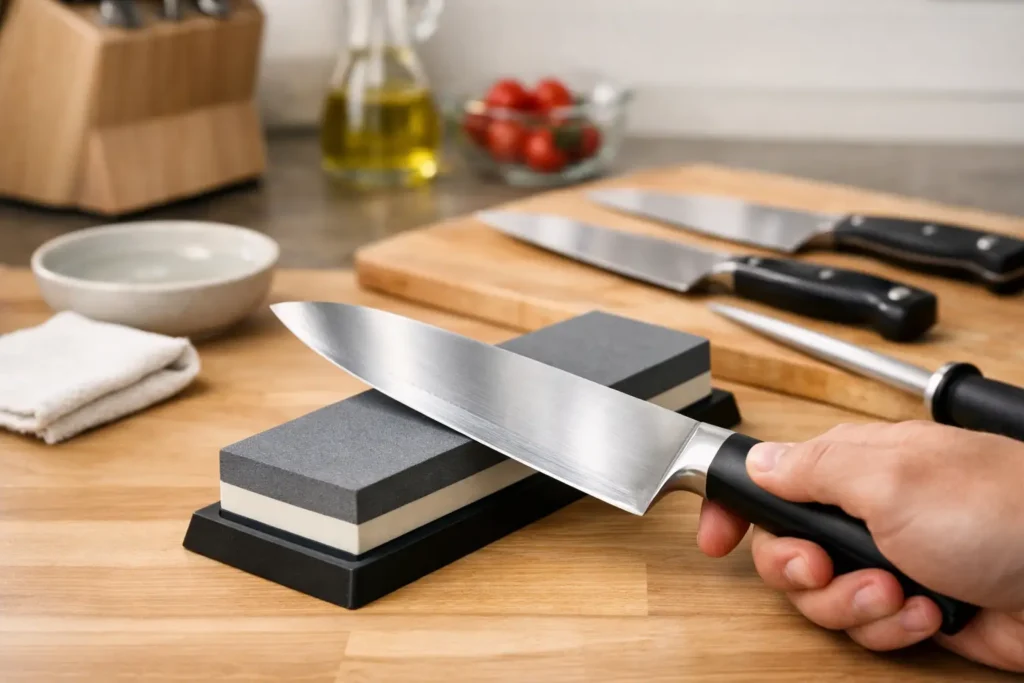
This is where many people get mixed up. Honing does not remove much metal. Sharpening does. Honing is routine maintenance that helps keep the edge aligned between sharpenings, while sharpening rebuilds the edge once it has actually worn down.
A knife can feel dull even when the edge is not fully worn away. Often, repeated use bends the very fine edge slightly out of line. A few light passes on a honing rod can bring it back into better working shape. That is why honing is useful for cooks who use their knives often, especially chef’s knives and prep knives.
There is a catch, though. Honing only helps if the knife still has an edge to realign. If the blade is truly dull, chipped, or rounded over, honing will not fix the problem. In that case, it needs proper sharpening.
How often should you hone?
It depends on how much you cook and what you cut. A home cook using one main knife several times a week might hone every few uses. A busy kitchen may hone daily or even more often during heavy prep. The goal is not to create a strict schedule. It is to pay attention to performance. If a knife starts feeling less crisp but is not truly blunt, honing is usually the first step.
Use light pressure. More force does not create a better edge. In fact, aggressive honing can do more harm than good, especially with thinner knives. A few controlled strokes per side are usually enough.
Washing and storage affect edge life more than people expect
A lot of edge damage happens after the cooking is done. Knives tossed into a sink, rattling in a dishwasher, or crowded into a drawer with other utensils tend to pick up nicks and rolled edges. Even a well-sharpened knife will not stay in good shape if it is stored carelessly.
Hand washing is the safer choice. Warm water, mild soap, and immediate drying protect both the edge and the blade overall. Dishwashers are rough on knives because of heat, moisture, detergent, and impact from other items. Even if a manufacturer says a knife is dishwasher safe, that does not mean dishwasher friendly if edge retention is the priority.
Storage should keep the edge from knocking into hard surfaces. A knife block works well if the slots are clean and the knives fit properly. Blade guards are a practical option for drawers. Magnetic strips can also work well, provided the knife is placed and removed carefully instead of slapped against the magnet. The best storage method is the one your household will actually use every day.
Cutting habits that protect the edge
People often assume maintenance starts with tools, but most of it starts with habits. The edge lasts longer when the knife is used with a little restraint.
Avoid cutting directly through bones with a standard kitchen knife unless that knife is built for the task. Be careful with hard pits, very stiff rinds, and dense frozen items. If you feel the blade resisting in an unusual way, forcing it usually makes things worse. Sometimes the safer move is to change tools or let the food thaw a bit more.
It also helps to match the knife to the job. A small paring knife used for large prep work gets overworked. A long chef’s knife used for delicate in-hand tasks can be awkward and less controlled. When the knife fits the task, the edge tends to wear more evenly and the work is safer.
Signs your knife needs sharpening, not just honing
If the blade slips on onion skin, tears herbs instead of slicing them, crushes tomatoes, or needs extra downward force on basic prep, it is probably past the point of simple honing. Another common sign is inconsistency. One section of the blade may cut fine while another drags or skips. That usually means the edge has worn unevenly.
Small chips are another clue. They can happen from hard contact, poor storage, or trying to power through the wrong material. Once that damage is present, sharpening becomes more than touch-up maintenance. It becomes edge repair.
How to maintain kitchen knife edges without overdoing it
Some knife owners do too little. Others do too much. Over-sharpening is real, and it shortens the life of the blade by removing more metal than necessary. The goal is not to grind a knife down every time it feels slightly off. The goal is to preserve a clean, usable edge as long as possible.
For most households, the right pattern is simple: use the right board, hone when needed, wash by hand, store carefully, and sharpen professionally when performance has clearly dropped. That keeps the edge working without turning maintenance into a hobby.
For commercial kitchens, the equation changes a little. Higher volume means edges wear faster, and downtime costs more. In that setting, regular service often makes more sense than waiting until knives are struggling through prep. A dependable sharpening schedule keeps workflow steady and helps staff work more safely.
When professional sharpening makes the most sense
There is value in routine home maintenance, but sharpening itself is where experience matters. The angle, the condition of the steel, the blade style, and the amount of wear all affect how the edge should be restored. Take off too much material, and you shorten the knife’s life. Too little, and the knife still performs poorly.
Professional sharpening is especially helpful when a knife has developed chips, a misshapen edge, or inconsistent cutting along the blade. It is also a practical choice for busy households and food businesses that would rather spend time cooking than troubleshooting stones, angles, and edge geometry.
That is one reason many Seattle-area customers work with Sharper Tools. Good edge maintenance is not just about getting a blade sharp once. It is about keeping the tools you rely on ready for daily use without adding hassle to your routine.
A sharp knife is easier to control, easier on ingredients, and easier on your hands. If you treat the edge with a little respect between sharpenings, you will get better performance and more life out of every blade. The simplest maintenance plan is usually the one that lasts: use it well, store it well, and get help before a truly dull edge starts costing you time.