A busy prep station can tell you everything about a kitchen’s knife program in about thirty seconds. If cooks are sawing through tomatoes, reaching for backup blades, or quietly avoiding certain house knives, the problem is not skill. It is system failure. A solid restaurant knife swap program example shows how to fix that without asking staff to stop service, box up tools, and wait days for sharpening.
For most restaurants, the appeal is simple. You keep a working set of sharp knives on hand, dull knives get swapped out on a schedule, and the kitchen stays in motion. No one has to guess which blade was last sharpened. No one has to limp through prep with a tired edge because the timing is bad. The result is better consistency, safer cutting, and fewer little delays that pile up over a week.
What a restaurant knife swap program example looks like
Picture a mid-size restaurant with a line, prep team, and weekend catering orders. It keeps twelve core kitchen knives in rotation – chef’s knives, paring knives, serrated utility knives, and a few specialty prep blades. Instead of sending those knives out whenever someone complains, the kitchen enrolls in a scheduled swap service.
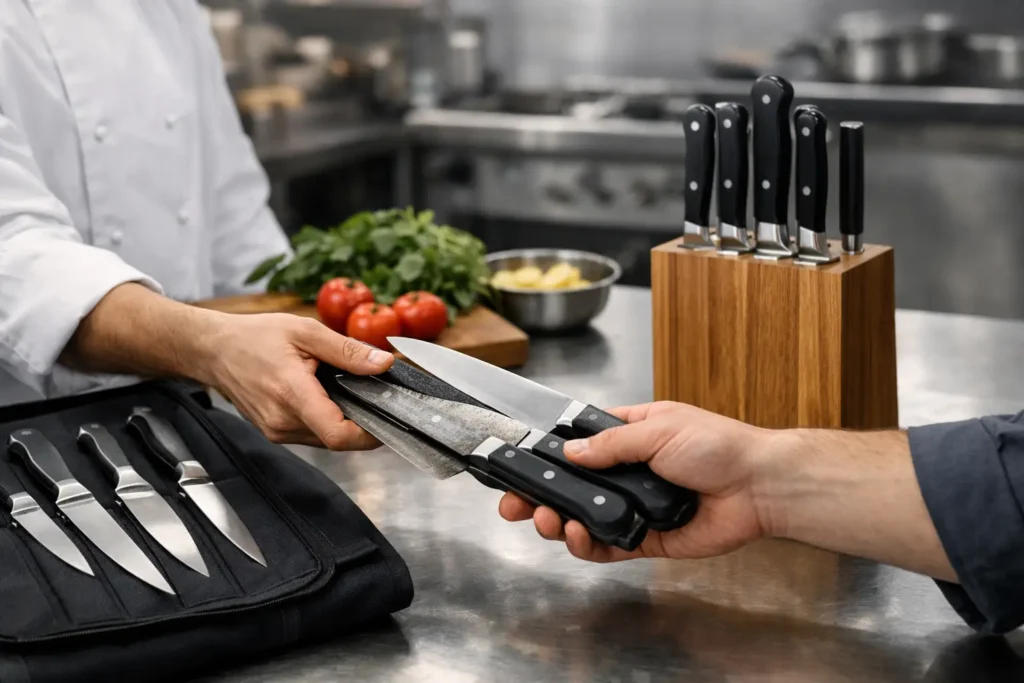
Every week, a service provider arrives with a matched set of sharpened replacement knives. The dull knives are collected, inspected, and taken off-site for sharpening and edge maintenance. The clean, sharpened set goes right back into use. The exchange takes minutes, not hours, and the kitchen never has to go without its essential tools.
That is the basic restaurant knife swap program example most operators are looking for. It is not complicated. It is a rotation system built around uptime.
Why kitchens move to a swap model
Restaurants usually switch to a knife swap program after they have already tried the informal version. Maybe one cook sharpens a few knives by hand. Maybe management drops them off somewhere on a slow day. Maybe there is a drawer full of mixed-condition backups that nobody really trusts. That setup can work for a little while, but it rarely holds up once volume increases.
A swap program solves a few practical problems at once. First, it creates a schedule. Sharp knives stop being a once-in-a-while fix and become part of regular kitchen operations. Second, it reduces disruption. Staff do not need to package knives, track return dates, or work around missing tools. Third, it improves consistency. A planned exchange means the whole team knows what kind of edge to expect.
There is also a safety angle that gets overlooked until someone is rushing. Dull knives require more force, slip more easily, and make repetitive prep more tiring than it should be. Sharp knives are not just about speed. They help cooks stay more controlled through long shifts.
A week-by-week operating example
Let us make the example more specific. Say a restaurant runs six days a week and does most of its heavy prep on Tuesday, Friday, and Saturday. Its knife swap schedule is set for Monday mornings before lunch prep ramps up.
On Monday, the service provider brings in twelve sharpened knives that match the restaurant’s standard kit. The provider collects the twelve knives used the previous week. Because the replacement set is already ready to go, the handoff is quick. The chef or kitchen manager checks the count, confirms any issues, and puts the sharpened set back into the knife rack or prep stations.
During the week, the kitchen uses those knives as usual. If one knife gets chipped from misuse or dropped on tile, that is flagged at the next exchange. Some programs include normal wear and edge maintenance in the regular service, while major damage may be handled differently. That part depends on the provider and the condition of the tools.
The key point is that the restaurant always has a complete working set. There is no dead period where the best knives are out for sharpening and the team is left improvising.
What should be included in the program
A good knife swap setup is built around the tools a kitchen actually uses, not a generic package that looks good on paper. Most restaurants need a core mix based on their menu and prep style. A heavy protein program will have different needs than a cafe, bakery, or catering operation.
At minimum, the provider and restaurant should agree on knife types, quantity, exchange frequency, and standards for condition. It also helps to define how damaged knives, missing knives, and special requests are handled. If the restaurant wants a slightly different edge profile for certain knives, that should be discussed up front.
This is where local service can make a real difference. A nearby provider can adjust based on what the kitchen is seeing, how fast the knives are wearing, and whether the current schedule still fits the workload. That kind of flexibility matters more than a one-size-fits-all plan.
The trade-offs to consider
A knife swap program is practical, but it is not identical to owning one favorite knife and having it sharpened forever. Some cooks are attached to a specific handle shape, blade feel, or brand. In a swap system, consistency matters, but exact personal preference may matter less than having reliable sharpness across the board.
There is also the question of cost. A swap program is an ongoing operating expense, so it needs to justify itself in labor savings, fewer disruptions, and better performance. For many kitchens, it does. For some very small operations with low volume, occasional sharpening may be enough.
Another trade-off is accountability. A swap system works best when the kitchen has a clear process for storage, handling, and signoff. If knives get scattered, abused, or left untracked, even a good service program will feel messy. The system does not need to be complicated, but it does need to be followed.
How to tell if your restaurant needs one
If your staff regularly complains about dull knives, you are already late. If prep takes longer than it should because certain knives are avoided, that is another sign. The same goes for kitchens where sharpening happens inconsistently, only after performance drops enough to become a problem.
You may also benefit from a swap program if your restaurant is growing. More covers, more prep volume, and more catering usually mean edge wear happens faster and downtime gets more expensive. In that case, moving from reactive sharpening to scheduled exchange is less of a luxury and more of an operational fix.
For Seattle-area restaurants, convenience matters too. A local service that can handle pickup, drop-off, or scheduled exchanges keeps managers from spending time on errands that do not help service. Sharper Tools built its Knife Swap & Go service around that exact reality – kitchens need sharp tools, but they do not need another task added to the day.
What to ask before starting
Before signing up for any program, ask a few practical questions. How often are knives swapped, and can that schedule change seasonally? Are the replacement knives matched by type and feel, or just roughly similar? What happens when a knife is damaged beyond normal wear? And who is responsible for keeping count at each exchange?
You should also ask how the provider handles edge quality. A knife can be technically sharpened and still not feel right on the board. Restaurants need edges that hold up in real prep, not just in theory. A provider who understands line work, prep volume, and kitchen pace will usually be better at setting the right expectations.
The bigger value is consistency
The best part of a restaurant knife swap program example is that it shows how a small operational change can remove a steady source of friction. Sharp knives do not create drama when they are managed well. They just make prep cleaner, faster, and less frustrating.
That is why the strongest programs are usually the least flashy. They are regular, predictable, and built around how a kitchen actually runs. If your team depends on its knives every shift, the goal is not just sharper edges. It is a better rhythm in the kitchen, week after week.
A good swap program should feel almost invisible once it is in place – and that is usually how you know it is working.