A dull knife usually announces itself at the worst time – halfway through onions, in the middle of dinner prep, or during a busy kitchen shift when every second matters. If you have been wondering what is best for sharpening knives, the honest answer is that the best option depends on the knife, the condition of the edge, and how much time you want to spend maintaining it.
That may sound less satisfying than naming one perfect tool, but it is the answer that saves people money and frustration. A home cook with two well-used chef knives has different needs than a restaurant kitchen running through prep all day. A thin Japanese-style blade needs a different touch than a heavy Western utility knife. The right sharpening method is the one that gives you a sharp, usable edge without removing more metal than necessary or creating extra hassle.
What is best for sharpening knives at home?
For most people, the best home option is a quality whetstone if they are willing to learn a little technique. It gives the most control, produces the best edge, and works on a wide range of kitchen knives. If the goal is long-term knife care, a stone is hard to beat.
That said, not everyone wants sharpening to become a skill they practice. If convenience matters more than precision, a good professional sharpening service is often the better choice. You get a properly restored edge without guessing at angles, overgrinding the blade, or turning a decent knife into a shorter one over time.
The common mistake is assuming faster always means better. Many quick-fix sharpeners do remove metal and make a knife feel sharper for a while, but they can be rough on the edge. That trade-off may be acceptable for an inexpensive workhorse knife. It is less appealing for a favorite chef knife you want to keep for years.
The main sharpening options and how they compare
Whetstones
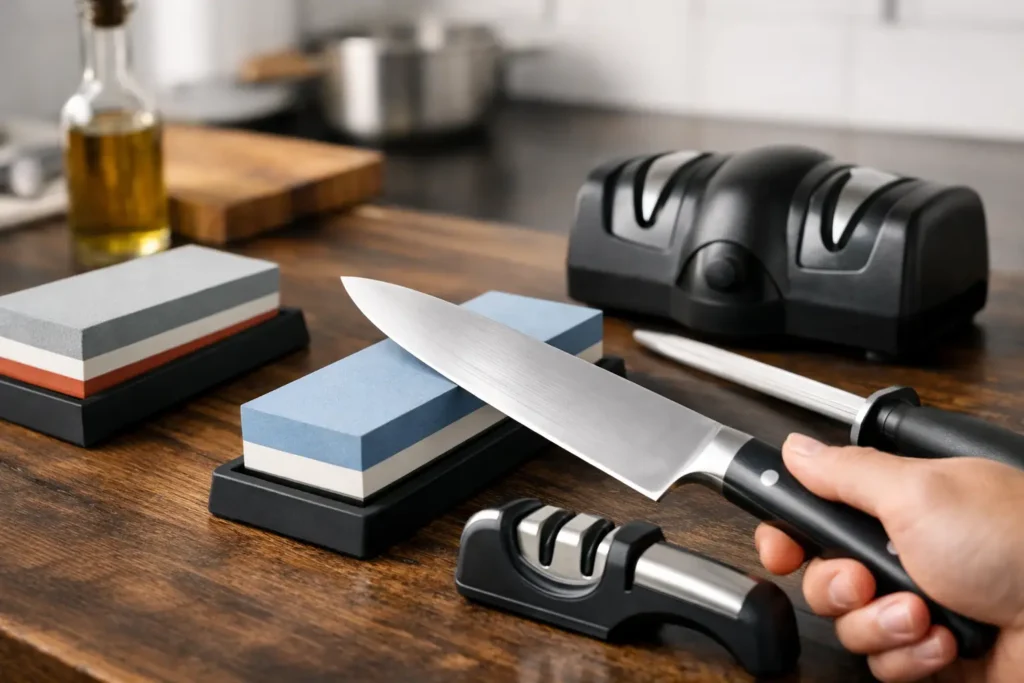
Whetstones are the standard for people who care about edge quality. They remove metal gradually, let you control the sharpening angle, and can create anything from a practical working edge to a very refined finish. They also work well for both routine touch-ups and more serious edge repair, depending on the grit.
The downside is the learning curve. Holding a steady angle takes practice, and using the wrong pressure can slow you down or create an uneven bevel. Stones also take a little setup and cleanup. For many households, that is still worth it because the results are excellent.
Pull-through sharpeners
Pull-through sharpeners appeal to busy people for obvious reasons. They are fast, compact, and easy to use. A few passes can improve a dull edge enough to get through dinner prep.
But they are a compromise. Many pull-through models remove metal aggressively and force the blade into a preset angle that may not match the knife. Over time, that can shorten blade life and leave a rougher edge than you would get from a stone or professional service. If you use one, it is best treated as a convenience tool, not the ideal method for every knife.
Electric sharpeners
Electric sharpeners sit in the middle. They are quicker and more consistent than manual pull-through devices, and some are quite good when matched to the right knives. For households that want speed with less guesswork, they can be a reasonable choice.
The trade-off is still control. You are relying on the machine’s angle and abrasives, not the actual shape and condition of your knife. They can also be too aggressive for certain blades. If your knives are inexpensive and heavily used, that may be fine. If you own better knives, caution matters.
Honing rods
A honing rod is often misunderstood. It is not really the answer to what is best for sharpening knives because it usually does not sharpen a dull knife. What it does is help maintain an edge between sharpenings by realigning the very thin cutting edge.
That makes it useful, but only for maintenance. If a knife is sliding on tomato skin or crushing herbs instead of slicing cleanly, a rod may improve it slightly, but it will not replace true sharpening.
Professional sharpening
For many people, professional sharpening is the most practical answer. It combines good edge quality with zero learning curve, and it is often the safest route for knives that matter to you. It also makes sense for commercial kitchens, where downtime and inconsistency create real operational problems.
A good sharpening service can evaluate the blade, choose an appropriate method, and remove only what is needed. That matters more than people realize. Every sharpening takes away a little metal, so the goal is not just sharpness today. It is preserving the knife for the long haul.
The best method depends on the knife
Not all knives want the same treatment. A sturdy European-style chef knife usually tolerates a little more abuse and can handle several sharpening methods reasonably well. A thinner Japanese-style knife often benefits from a gentler, more precise approach. Serrated knives are their own category and need different tools and technique than straight-edge blades.
This is where one-size-fits-all sharpeners can disappoint. They are built for speed and simplicity, not for adapting to blade thickness, steel type, edge angle, or existing damage. A chipped knife, a rolled edge, and a simply dull knife are three different problems, and they should not be treated exactly the same way.
Sharpness is not just about performance
People usually notice dull knives because prep gets annoying. You need more pressure, cuts get messy, and simple jobs take longer. But the bigger issue is safety.
A sharp knife cuts where you direct it. A dull knife tends to slip, twist, or crush its way through food, which means your hand does more compensating. That is when accidents happen. In home kitchens, that creates frustration. In restaurants and catering operations, it creates slowdowns and unnecessary risk.
There is also a quality issue. A sharp knife gives cleaner cuts on produce, proteins, and herbs. It makes prep feel smoother and helps food look better. For gardeners and homeowners, the same principle applies to other tools. A clean edge simply works better and puts less strain on the user.
When sharpening at home makes sense
If you enjoy maintaining your tools and want more control, home sharpening is absolutely worth learning. A whetstone setup can serve you well for years, and routine touch-ups can keep knives in good shape between more serious sharpenings. It is a practical skill, especially if you cook often.
It helps to be realistic, though. Sharpening well takes repetition. If your knives are already very dull, chipped, or uneven, the first restoration can take more time than most people expect. And if the angle is inconsistent, you may end up with a knife that is technically sharper but still not cutting as cleanly as it should.
For a lot of busy households, the sweet spot is simple. Use a honing rod for maintenance, avoid abusing the edge on glass or stone surfaces, and have the knives professionally sharpened when performance drops off.
When professional sharpening is the better choice
Professional sharpening makes the most sense when convenience matters, when the knives have real value, or when consistency is important. That covers a lot of ground. Home cooks who want dependable results, restaurants that cannot afford downtime, and anyone with a drawer full of dull blades all benefit from having the work handled properly.
It is also the better option when a knife has visible damage, an uneven bevel, or years of neglect. Those are the jobs where guesswork tends to cost more than it saves. A reliable local service can restore the edge without turning the process into a weekend project.
For Seattle-area customers, that practical side matters. Pickup and drop-off options, fast turnaround, and experience with everyday kitchen tools can make professional sharpening the easiest way to keep things working the way they should. That is especially true for commercial kitchens that need sharp knives ready to go without interrupting service.
So, what is best for sharpening knives?
If you want the best edge and are willing to learn, a whetstone is usually the best tool for sharpening knives at home. If you want the best mix of quality, convenience, and long-term knife care, professional sharpening is often the smarter choice. Pull-through and electric sharpeners can help in certain situations, but they are usually more about speed than precision.
The better question is not which tool wins on paper. It is which option fits your knives, your schedule, and how much edge quality really matters in your day-to-day use. A sharp knife should make work easier, safer, and faster. If your current method is not doing that, it may be time for a better one.