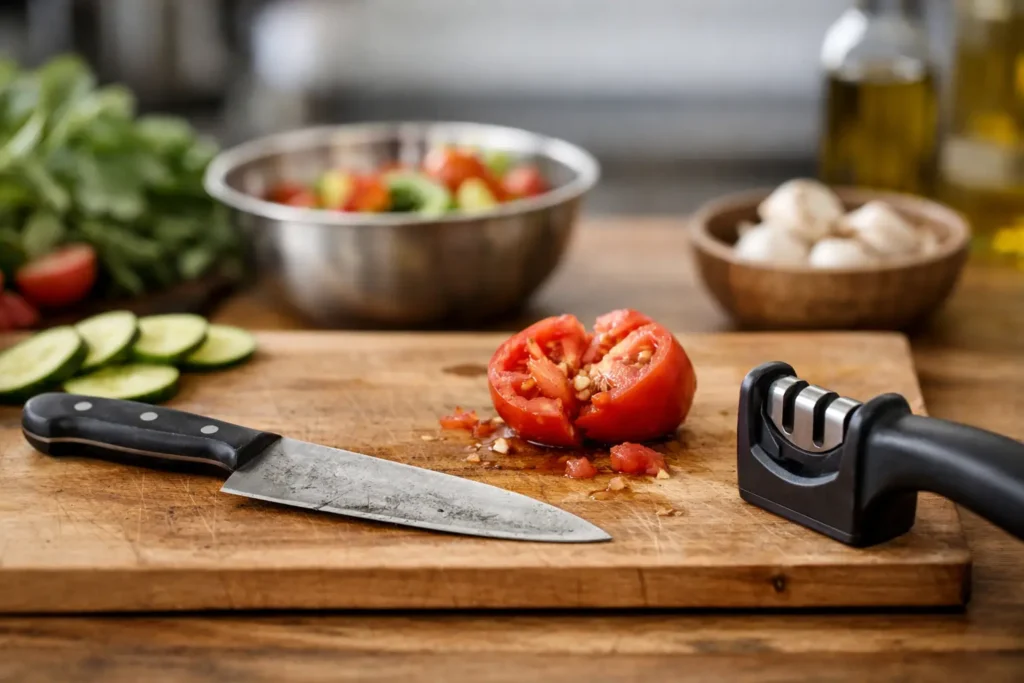
A ripe tomato should not turn into a slippery, crushed mess before your knife breaks the skin. If it does, your blade is giving you a clear signal. Knowing how to tell knives need sharpening helps you prep meals faster, protect the food you are cutting, and avoid the extra force that makes kitchen work less safe.
Many people wait until a knife feels completely useless before addressing it. By then, they may be sawing through onions, tearing herbs, and pressing hard enough to risk a slip. A well-maintained knife does not need to be razor-thin or intimidatingly sharp. It simply needs a clean, consistent edge that does the cutting for you.
How to Tell Knives Need Sharpening at Home
The easiest signs show up during ordinary meal prep. You do not need a specialized gauge or a complicated trick. Pay attention to what the knife does when it meets common foods.
It slides off tomato skin, peppers, or onions
A sharp knife bites into smooth skin with light, controlled pressure. A dull one skates across the surface before it finally catches. Tomatoes are a useful test because their skin is thin but resilient. Bell peppers, apples, and onions can reveal the same problem.
If you find yourself pushing down harder or using a sawing motion just to start a cut, the edge likely needs attention. This is especially noticeable with a chef’s knife or paring knife that you use often.
It crushes soft food instead of slicing it
When a blade is dull, it presses food apart before it cuts. You may see bruised berries, flattened tomato slices, ragged herbs, or torn meat fibers. The issue is not only appearance. Crushed ingredients can release more moisture, making a cutting board messy and affecting texture in salads, sandwiches, and garnishes.
A sharp knife leaves cleaner surfaces. It should slice through a mushroom cap, a ripe peach, or fresh basil with minimal pressure and without turning delicate food into a pile of fragments.
You are using more force than you used to
This is one of the most reliable warning signs because it is often felt before it is seen. Think about whether your hand, wrist, or shoulder is working harder during routine chopping. If a knife that once handled carrots comfortably now requires repeated downward pressure, it is probably dull.
More force does not solve the problem. It raises the chance of the blade slipping sideways or forward when it suddenly breaks through food. A dull knife can be more hazardous than a sharp one for exactly this reason: the user has to compensate.
Your cuts look uneven or ragged
A knife does not need to produce restaurant-perfect slices to be working properly. Still, it should make predictable cuts. If vegetable pieces split unexpectedly, onion layers tear, or a slice wanders off line even when your technique is steady, inspect the edge.
Uneven cuts can also result from knife skills, blade shape, or a poor cutting surface. But when a familiar knife becomes harder to control, sharpening is a sensible first step.
The paper test feels rough or inconsistent
A sheet of plain printer paper offers a quick check. Hold the paper upright and lightly draw the knife through an edge. A knife in good condition should cut smoothly and continuously. If it snags, tears, or only cuts in certain spots, the edge may be dull or uneven.
Treat this as a clue, not the final verdict. Paper is different from food, and a knife can pass this test while still performing poorly on tomatoes or herbs. The best assessment comes from combining a simple test with what you notice in daily use.
Dull, Rolled, or Damaged: What Is the Difference?
Not every underperforming knife needs the same service. An edge can be dull from normal wear, rolled slightly to one side, or chipped from contact with hard materials. Those conditions feel different in use.
A normally dull edge feels generally resistant all along the blade. It may still cut, but it takes extra pressure from heel to tip. This is common after weeks or months of regular home cooking, depending on the knife, cutting board, and what you prepare.
A rolled edge is bent rather than worn away. It can make the blade feel sharp in one direction and dull in another, or cause it to drag through food. A honing rod may realign a lightly rolled edge, but it does not remove enough metal to restore an edge that has truly become dull.
Chips, flat spots, and visible nicks call for professional sharpening. You may feel the knife catch at one point while slicing or see tiny irregularities when you look along the edge in good light. Avoid trying to force the knife through food or aggressively grinding it at home. Removing too much metal can shorten the usable life of the blade.
Honing Is Helpful, but It Is Not Sharpening
This distinction saves a lot of frustration. Honing realigns the fine edge of a knife. Sharpening creates a new cutting edge by removing a small amount of material. Both have a place, but they are not interchangeable.
For a frequently used kitchen knife, a few careful passes on a honing rod can help maintain performance between sharpenings. The rod should match your skill level and be used with control, not speed. The dramatic rapid honing seen in professional kitchens is not necessary for home cooks.
If honing does not improve how the knife cuts a tomato or onion, the knife needs sharpening. Continuing to hone a worn edge will not bring it back. Think of honing as straightening a slightly bent line, while sharpening redraws the line when it has faded away.
How Often Should You Sharpen Kitchen Knives?
There is no calendar date that works for every household. A knife used three times a day on a hard surface will wear differently than one used for weekend meal prep on a wood or quality plastic board.
For many home cooks, professional sharpening once or twice a year is a practical starting point. People who cook heavily, process large amounts of produce, or rely on their knives for frequent entertaining may need service more often. Restaurant kitchens and catering operations typically need a dependable maintenance schedule rather than waiting for individual knives to fail during prep.
The better rule is performance-based: sharpen when the knife starts sliding, crushing, dragging, or requiring extra force. Addressing the problem early generally means less material has to be removed to restore the edge.
Habits That Keep Knives Sharp Longer
Good daily care extends the time between sharpenings. The biggest difference usually comes from the cutting surface. Use wood or quality plastic boards rather than glass, ceramic, stone, or a countertop. Hard surfaces wear an edge down quickly.
Wash knives by hand when possible, dry them promptly, and store them where the edges will not collide with other utensils. A blade guard, knife block, magnetic strip, or properly fitted drawer organizer can prevent the small impacts that create dull spots and chips.
Also use the right knife for the task. Kitchen knives are made to cut food, not pry open lids, cut through bone, scrape a board with the edge, or separate frozen items. Using the spine of the knife to move chopped food from the board is a small habit that protects the edge.
When Professional Sharpening Makes Sense
At-home sharpeners can be useful for someone who understands their knife style and can maintain a consistent angle. The trade-off is that many pull-through devices remove more metal than necessary or produce a rough edge. They may be convenient, but convenience is not always the same as long-term tool care.
Professional sharpening is particularly useful for quality kitchen knives, blades with chips or uneven wear, and households that want reliable results without learning a new technique. It is also a practical option for busy Seattle-area kitchens where a dull knife becomes another task on an already long list. Sharper Tools can restore kitchen knives while helping customers keep the tools they already own in service longer.
A sharp knife should make prep feel calm and predictable. The next time a tomato slips, an onion tears, or your hand starts pushing harder than it should, treat that moment as useful feedback. A little timely edge care can make tonight’s meal easier and keep your favorite knife ready for the next one.