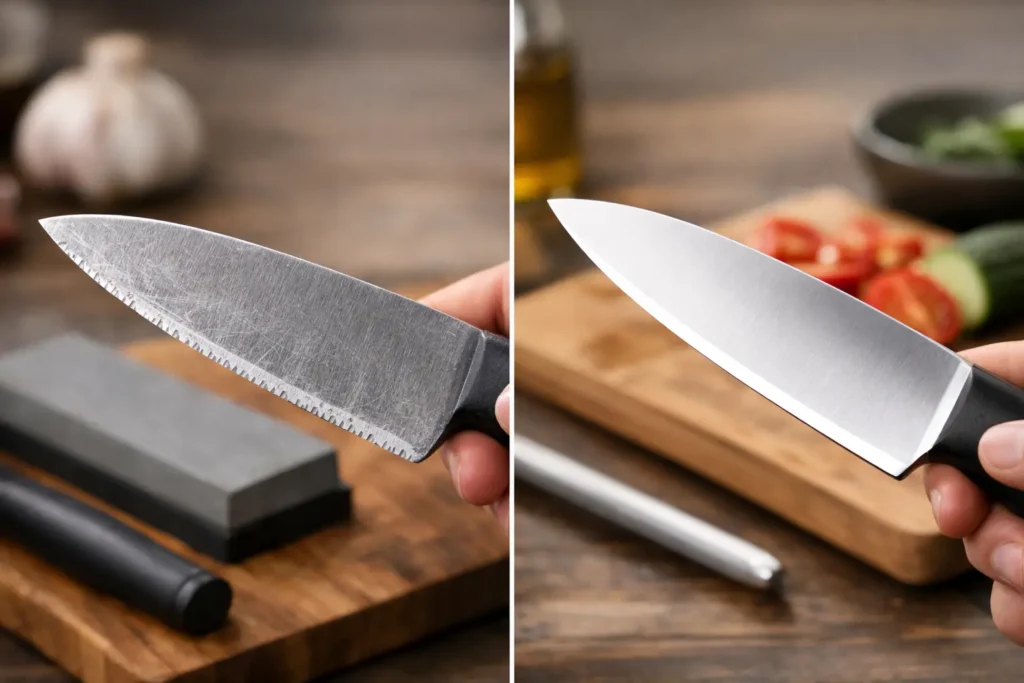
You can feel a dull knife before you even see it. It slips on tomato skin, crushes herbs instead of slicing them, and turns simple prep into extra work. The difference before and after knife sharpening is not subtle when you use your knives every day. It shows up in speed, safety, cleaner cuts, and how much effort your hand and wrist have to put into each task.
For Seattle-area home cooks, busy households, and commercial kitchens, that difference matters because dull knives waste time. They also make good tools feel cheap. A quality chef knife with a tired edge can perform worse than an inexpensive knife that has been properly sharpened and maintained.
What changes before and after knife sharpening
Before sharpening, most knives do not look dramatic enough to seem like a problem. The edge may not appear chipped or bent from across the room. But at the cutting line, the bevel has often become rounded over through normal use. Instead of a fine edge that parts food cleanly, you get a blunt surface that pushes, tears, and skids.
After sharpening, the edge geometry is restored. That means the knife can bite into the material right away instead of forcing you to add pressure. On produce, you notice cleaner slices and less bruising. On proteins, you get more control and less dragging. On herbs, you cut rather than mash, which helps both appearance and texture.
The practical result is simple. Jobs that used to feel annoying become routine again. If you cook every night, pack lunches, prep bulk meals, or run a kitchen line, that change adds up quickly.
The real before and after knife sharpening test
A lot of people assume a dull knife is only a minor inconvenience. In practice, it affects almost every part of food prep.
Before sharpening, onions tend to crack apart under pressure, peppers wrinkle before the blade gets through the skin, and boneless meats can stretch or tear instead of slicing evenly. You may find yourself sawing back and forth, using your shoulder instead of your fingers, or bracing the cutting board because the knife feels unpredictable.
After sharpening, the blade starts the cut with less force. That does not just make prep faster. It makes movement more controlled. You can make thin slices with less effort, keep cuts more consistent, and reduce the chance that the blade slips sideways because you are pushing too hard.
That last point matters. Many people think a sharper knife must be more dangerous. In reality, a properly sharpened knife is usually safer to use because it does what you expect it to do. A dull edge invites compensation. People twist the blade, lean harder, or rush through repetitive prep because they are frustrated. That is where control starts to disappear.
Why dull knives get worse faster than most people expect
Knife edges do not go from sharp to useless overnight. Most lose performance gradually, which makes the decline easy to ignore. You adapt without noticing. You press harder. You switch to a sawing motion. You stop using one knife and grab another.
The problem is that continuing to use a dull knife can make future sharpening more involved. Minor edge wear is normal and manageable. But repeated use on a weakened edge can lead to flat spots, rolls, and chips that require more material removal to correct. That shortens the knife’s service life over time, especially if the knife is also being used on hard surfaces or stored carelessly.
This is one reason regular maintenance makes sense. Sharpening is not only about getting a better cut today. It is also about preserving the tool you already paid for.
What professional sharpening fixes that home touch-ups often miss
A honing rod and a sharpener from the kitchen drawer are not the same thing as actual sharpening. Honing can help align a slightly fatigued edge between sharpenings. A simple pull-through device may create a quick improvement on some knives. But neither always addresses the underlying condition of the edge well, and some tools remove metal aggressively or unevenly.
Professional sharpening focuses on restoring the bevel consistently and matching the treatment to the knife. That matters because kitchen knives vary in steel, thickness, intended use, and wear pattern. A heavily used prep knife in a restaurant needs a different level of attention than a lightly used utility knife in a home kitchen.
The goal is not just to make the knife feel sharp for a day or two. It is to create an edge that cuts cleanly and holds up under normal use. For customers, the benefit is straightforward. You get your knife back ready to work, without guessing whether the angle is right or whether too much metal has been removed.
Before and after knife sharpening in a home kitchen
At home, the biggest change is usually ease. Meal prep takes less effort, and the knife feels more predictable. If you cook a few nights a week, you may not think of sharpening as urgent, but it has a way of improving every routine task at once.
Slicing fruit for school lunches gets quicker. Chopping vegetables for soups or stir-fries feels cleaner. Carving cooked meats becomes neater. Even basic jobs like trimming fat or halving squash feel less like a wrestling match.
There is also a value question. Many homeowners replace knives too early because they assume the tool is worn out. Often, the problem is just the edge. A well-made knife that has gone dull can feel new again after proper sharpening. That is practical, less wasteful, and easier on the budget than replacing tools that still have years of life left.
Before and after knife sharpening in a commercial kitchen
For restaurant operators, caterers, and prep teams, dull knives create drag in the workflow. A few extra seconds on each cut may not sound like much, but across prep lists and service volume, it becomes lost time and inconsistent results.
Before sharpening, staff often compensate in ways that reduce efficiency. They may avoid certain knives, slow down on repetitive tasks, or reach for backup tools that are only slightly better. Product quality can suffer too. Ragged cuts affect appearance, and inconsistent slicing can change cooking times and portion control.
After sharpening, the entire line feels smoother. Prep moves faster, cuts are more consistent, and the knives in rotation become dependable again. That reliability is a real operational advantage. It helps teams stay focused on output instead of working around equipment issues.
For businesses, convenience matters as much as edge quality. A sharpening service has to fit the schedule, not interrupt it. That is why local pickup, drop-off, and recurring service options matter so much in day-to-day operations.
Signs your knife needs sharpening now
You do not need a dramatic failure to know it is time. If the blade struggles to start a cut on tomato skin, slips on onion layers, tears herbs, or requires extra downward force, the edge is no longer doing its job. If one area of the knife cuts worse than another, that can signal uneven wear. And if you have started avoiding a knife you used to like, dullness is often the reason.
It also depends on frequency of use. A home cook may only need professional sharpening occasionally, especially with good habits between services. A busy kitchen may need a much tighter maintenance rhythm. Neither is right or wrong. The useful schedule is the one that keeps the tool performing without letting the edge deteriorate too far.
Getting better results after sharpening
Sharpening helps most when it is paired with basic edge care. Use a cutting board that is easier on the blade, keep knives clean and dry, and store them so the edge is not banging into other tools. If you use a honing rod, use it correctly and gently. Honing can extend the time between sharpenings, but it does not replace them.
It is also worth being realistic. Sharpening restores performance, but it cannot turn every damaged or low-quality blade into a premium knife. Some knives hold an edge longer than others. Some need more frequent service because of how they are used. That does not mean sharpening is not worth it. It means good results come from matching the service to the tool and the workload.
For Seattle households and food businesses, professional sharpening is one of those small maintenance steps that pays off right away. The difference before and after knife sharpening shows up the next time you cut an onion, prep a case of produce, or work through a dinner rush. When your knife does its job cleanly, your whole routine gets easier.