A tomato that squashes instead of slices usually tells you more about your knife than your dinner prep. Most edge problems do not start with a ruined blade. They start with small habits, the wrong maintenance tool, or using a good knife on a bad surface. If you are trying to find the best tools for knife edge care, the right answer is not one gadget. It is a small, practical setup that matches how often you cook, what kind of knives you own, and whether you want to maintain the edge yourself or hand it off when it needs real sharpening.
What the best tools for knife edge care actually do
A lot of people use sharpening and honing as if they mean the same thing. They do not. Honing straightens a slightly rolled edge so the knife feels sharper again. Sharpening removes metal to create a fresh edge. Stropping refines and cleans up that edge. Cleaning and storage matter too, because a sharp knife can lose performance quickly if it is knocked around in a drawer or left wet.
That distinction matters because buying the wrong tool often leads to frustration. If your knife is truly dull, a honing rod will not fix it. If your edge is still in decent shape, an aggressive sharpener may wear it down faster than necessary. Good edge care is less about doing more and more about doing the right thing at the right time.
The core tools worth having
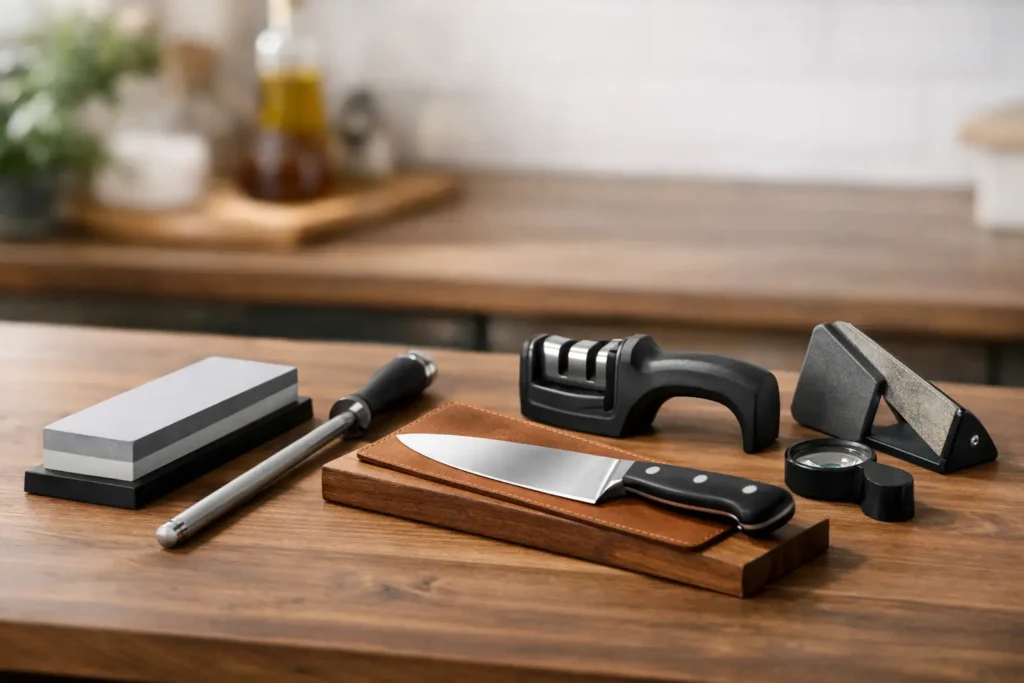
For most home kitchens, the best starting point is a ceramic honing rod, a quality whetstone, a strop, and a safe storage solution. That may sound like a lot, but each tool has a clear job.
Ceramic honing rod
A ceramic rod is one of the most useful maintenance tools because it helps restore day-to-day performance without taking off much material. It is especially helpful for cooks who use their chef’s knife several times a week and notice the edge feeling a little tired before it is truly dull.
Compared with a traditional grooved steel rod, ceramic tends to be a better fit for modern kitchen knives because it is gentler and more effective at light edge maintenance. The trade-off is that ceramic can break if dropped, so it needs a little care.
Whetstones
If you want real sharpening control, whetstones are hard to beat. A medium grit stone in the 800 to 1000 range handles most dull kitchen knives. A finer stone, around 3000 to 6000 grit, refines the edge after the main work is done.
Whetstones ask more from the user than a pull-through sharpener, but they also give better results when used correctly. You control the angle, the pressure, and how much metal is removed. That matters if you own better kitchen knives or simply want them to last. The downside is the learning curve. If you rush, use poor angle control, or skip flattening the stone, you can end up with an uneven edge.
Leather strop
A strop is often overlooked, but it is one of the easiest ways to keep a knife feeling crisp between sharpenings. After sharpening, it helps refine the apex of the edge. Between sharpenings, it can clean up minor fatigue and improve slicing feel.
This is not a substitute for sharpening, and it will not rescue a badly dulled knife. Still, for regular upkeep, it earns its place. It is simple, low-risk, and especially useful for home cooks who want their knives to stay pleasant to use longer.
Knife storage that protects the edge
Edge care is not only about sharpening tools. Storage is part of the system. A knife block with clean slots, a blade guard, a magnetic strip with proper spacing, or a drawer insert all help prevent edge damage.
Loose drawer storage is one of the fastest ways to shorten the life of a good edge. It also creates a safety problem. If the knife bangs against metal utensils or other blades, sharpness drops fast. Good storage is not flashy, but it saves money and reduces how often the knife needs service.
Tools that can help, but depend on the user
Not every tool fits every kitchen. Some options are convenient, but they come with trade-offs.
Pull-through sharpeners
These are popular because they are fast and easy to understand. For inexpensive household knives, they can be a reasonable short-term fix. If someone wants a quick result and is not concerned about perfect edge geometry, a decent pull-through model may be good enough.
The catch is that many remove more metal than necessary and offer limited angle flexibility. Over time, that can shorten the life of the knife. They are usually a poor match for higher-end kitchen knives or anyone who wants a cleaner, longer-lasting edge.
Electric sharpeners
Electric sharpeners can work well in busy homes or light commercial settings where speed matters. They reduce some of the skill required and can produce consistent results on knives that match the machine’s angle design.
Still, they are not universal. If the preset angle does not suit your knife, performance may suffer. They also remove metal more aggressively than careful hand sharpening. For people with a mixed collection of knives, they can be useful, but not always ideal.
Best tools for knife edge care by use case
The right setup depends on what your week looks like.
If you are a home cook using two or three kitchen knives regularly, a ceramic honing rod, a medium whetstone, and proper storage usually cover the basics. That setup gives you daily maintenance, occasional sharpening, and protection between uses.
If you cook a lot and care about cleaner cuts on herbs, proteins, and produce, adding a fine stone and a strop makes sense. You will get a more refined edge and better control over how the knife performs.
If you run a restaurant, cater, or prep large volumes of food, consistency matters as much as sharpness. In that case, the best tool may not be another countertop device. It may be a reliable sharpening service and a rotation plan that keeps knives ready without slowing the kitchen down. For many professionals, that is more practical than trying to fit proper sharpening into an already packed schedule.
What to avoid when caring for knife edges
One of the biggest mistakes is using too much force with any maintenance tool. Heavy pressure on a rod or stone rarely improves the result. It usually creates more wear and less control.
Another issue is treating every knife the same. A budget utility knife and a harder Japanese-style chef’s knife may need different angles and a different touch. The best tools for knife edge care are only as good as the way they are matched to the blade.
It is also worth avoiding glass, stone, or very hard cutting surfaces. Even a freshly sharpened knife loses its edge quickly on the wrong board. Wood and quality plastic boards are usually the safer choice for edge retention.
When professional sharpening is the better tool
There is a point where home maintenance stops being the best answer. If a knife has chips, a broken tip, a badly uneven bevel, or years of poor sharpening behind it, professional service is usually the smarter move. The same goes for busy households and commercial kitchens where time matters more than learning sharpening technique.
A good sharpening service does more than make a knife feel sharp for a day or two. It restores the edge shape, removes damage correctly, and helps extend the life of the tool. For Seattle-area customers balancing work, family, or kitchen service, that convenience can be just as valuable as the sharpening itself. That is part of why services like Sharper Tools make sense for people who want dependable results without trial and error.
A simple edge care routine that works
For most knives, the practical routine is straightforward. Use the knife on a proper cutting board, wash and dry it by hand, store it so the edge is protected, and touch it up with a ceramic rod as needed. When honing stops bringing the edge back, sharpen it on a whetstone or have it professionally serviced. A strop can help stretch the time between full sharpenings.
That routine is not complicated, and it does not require a drawer full of gadgets. It just respects how edges wear in real life.
If you want your knives to cut cleanly, feel safer in the hand, and last longer, buy fewer tools and choose better ones. The best edge care setup is the one you will actually use consistently, whether that means a stone on your counter or a trusted local sharpening service on your schedule.