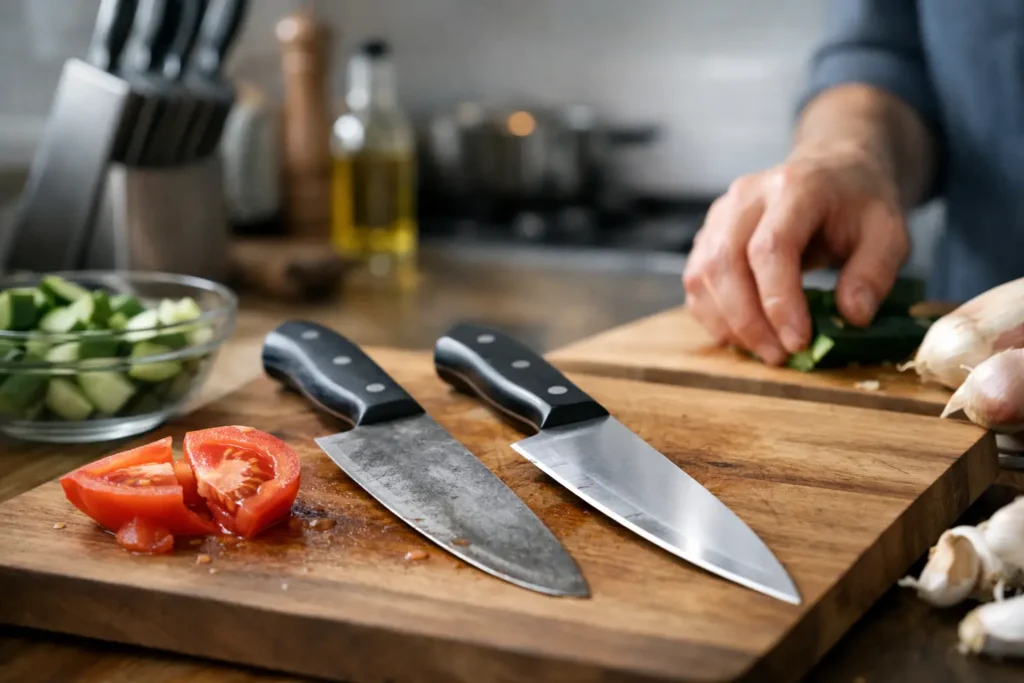
A tomato skin refuses to give. You press harder, the knife suddenly slides sideways, and your free hand is much closer than it should be. That ordinary kitchen moment answers the question: can dull knives be dangerous? Yes. A dull knife often requires more pressure and offers less control, which raises the chance of a slip and a cut.
This does not mean every less-than-perfect knife is an emergency. A knife that has lost a little bite may simply make dinner prep frustrating. But once you are sawing through soft food, crushing herbs, forcing the blade through an onion, or changing your grip to get more leverage, it is time to take the edge seriously.
Why dull knives can be dangerous
The common belief that a sharp knife is more dangerous makes sense at first. A sharp edge cuts quickly, after all. The difference is predictability. A sharp, properly maintained knife enters food where you aim it with moderate pressure. A dull blade tends to skid across smooth surfaces or stall halfway through denser foods.
When the blade does not move as expected, people compensate. They press down harder, angle the knife awkwardly, put a hand on top of the blade, or rush the final cut. Those adjustments create the real safety problem. If the knife slips, the extra force behind it can make the resulting injury worse.
Dull knives can also pull food apart rather than slice it cleanly. A ripe tomato gets squashed before the blade breaks the skin. An onion shifts on the board. A squash requires so much force that stable technique becomes harder to maintain. Every one of those situations reduces control.
For busy home kitchens, the risk often appears when multitasking. You may be watching a pan, helping a child with homework, or trying to finish prep before guests arrive. Restaurant teams face a similar issue under service pressure. A knife that needs repeated passes through the same ingredient slows the work and makes unsafe shortcuts more tempting.
The warning signs your knife needs attention
You do not need a formal test to spot a dull knife. Start with normal food prep. If the blade will not slice cleanly through a tomato, pepper skin, grape, or sheet of paper, its edge likely needs work. If it tears fresh herbs instead of making neat cuts, that is another useful clue.
Pay attention to how much pressure you are using. A chef’s knife should not require a hard downward push to cut common vegetables, boneless meat, or fruit. It should feel controlled, not effortless in every situation, but clearly capable of doing the job without a struggle.
A few other signs are worth watching for:
- The knife slips off onions, carrots, or round produce before it begins cutting.
- You find yourself sawing back and forth through foods that once sliced easily.
- Cut edges look ragged, bruised, or crushed instead of clean.
- The blade has visible chips, flat spots, bends, or a tip that has broken off.
Visible damage matters because sharpness is not the only issue. A chipped edge can catch unexpectedly in food. A bent blade may not track straight. In those cases, avoid trying to grind away the problem with a quick home fix. A professional can evaluate whether the knife can be safely restored and how much material should be removed.
Sharpness and honing are not the same thing
Many kitchen knives feel dull even when the edge is still present. That can happen because regular use gradually bends the thin edge to one side. Honing realigns that edge. Sharpening removes a small amount of metal to create a new cutting edge.
A honing rod or similar honing tool can be useful between sharpenings, particularly for knives used several times a week. Used gently and correctly, it helps keep a maintained edge cutting well. It cannot repair a truly worn edge, chips, or major damage. Running a dull knife repeatedly on a honing rod may make it feel slightly better for a short time, but it will not replace sharpening.
There is also a trade-off with aggressive at-home sharpeners. Pull-through devices are convenient, but some remove metal quickly or create a rough, short-lived edge. That may be acceptable for an inexpensive utility knife, but it is not always the best choice for a favorite kitchen knife or a knife set you want to keep for years. Proper sharpening should restore performance while preserving the useful life of the blade.
How to use a less-sharp knife more safely until it is serviced
If you notice a knife is dull during prep, the safest option is to set it aside and use a sharper knife. If that is not practical, slow down rather than forcing the cut. Stabilize food on a solid cutting board, keep fingers curled back in a claw grip, and cut flat-sided foods with the stable side down.
Do not try to power through hard ingredients by placing your palm on top of the blade or twisting the knife in the food. For very firm items, use the right tool and technique, or wait until the knife has been sharpened. A knife should guide the cut. It should not require a wrestling match.
Keep the work area dry and clear. A wet handle, slippery cutting board, crowded counter, or dish towel near the cutting path can turn a manageable task into an accident. For round foods, create a stable flat surface before cutting further. These habits help with any knife, but they matter even more when the edge is not performing well.
Never leave a dull knife loose in a sink. Someone reaching into soapy water cannot see the blade, and a dull edge can still cut skin. Wash it carefully, dry it right away, and store it where the edge is protected. A knife block, magnetic strip installed securely, blade guard, or drawer organizer helps prevent both injuries and edge damage.
When professional sharpening makes sense
Most household knives benefit from professional sharpening when normal cooking becomes noticeably harder. For a home cook, that may be a few times a year or once a year depending on how often the knives are used, the cutting surface, and the type of food prepared. Cutting on glass, ceramic, stone, or a plate will wear an edge much faster than using a wood or quality plastic cutting board.
Commercial kitchens need a more regular plan. Prep volume, menu demands, and multiple people using the same knives can wear edges quickly. A restaurant cannot afford to have its prep work slowed down by blades that crush produce, shred proteins, and require excess force. Reliable edge maintenance is a practical safety measure as well as an efficiency measure.
That is why a scheduled service approach can be useful for restaurants and caterers. With a knife swap program, staff can keep working with sharp knives rather than waiting for a set to be serviced. It reduces disruption during busy operations and helps make knife condition part of the routine instead of an afterthought.
Professional service is especially worthwhile for knives with chips, uneven edges, broken tips, or blades that have been sharpened unevenly over time. The goal is not simply to make a blade feel sharp for a day. It is to create a clean, consistent edge that suits how the knife is used.
A sharper kitchen is also a more efficient kitchen
Safety is the strongest reason to address dull knives, but better prep is a close second. Clean cuts help vegetables cook more evenly, herbs stay fresher-looking, and proteins slice more neatly. You spend less time repeating cuts and less energy fighting the food on the board.
There is a value side to it, too. Good knives are made to be maintained. Replacing them whenever they feel dull creates unnecessary waste and expense, while regular sharpening can extend the useful life of tools you already know and like. The same practical thinking applies to scissors, garden tools, and mower blades: maintained edges work better and make the job easier.
For Seattle-area households and kitchens that need a dependable option, Sharper Tools can help bring everyday knives back to safe, useful working condition through professional sharpening and convenient local service. A knife should support your hands, not make you compensate for it. When prep starts feeling like a struggle, treating the edge before the next meal is a simple way to keep the kitchen safer and the work moving.