
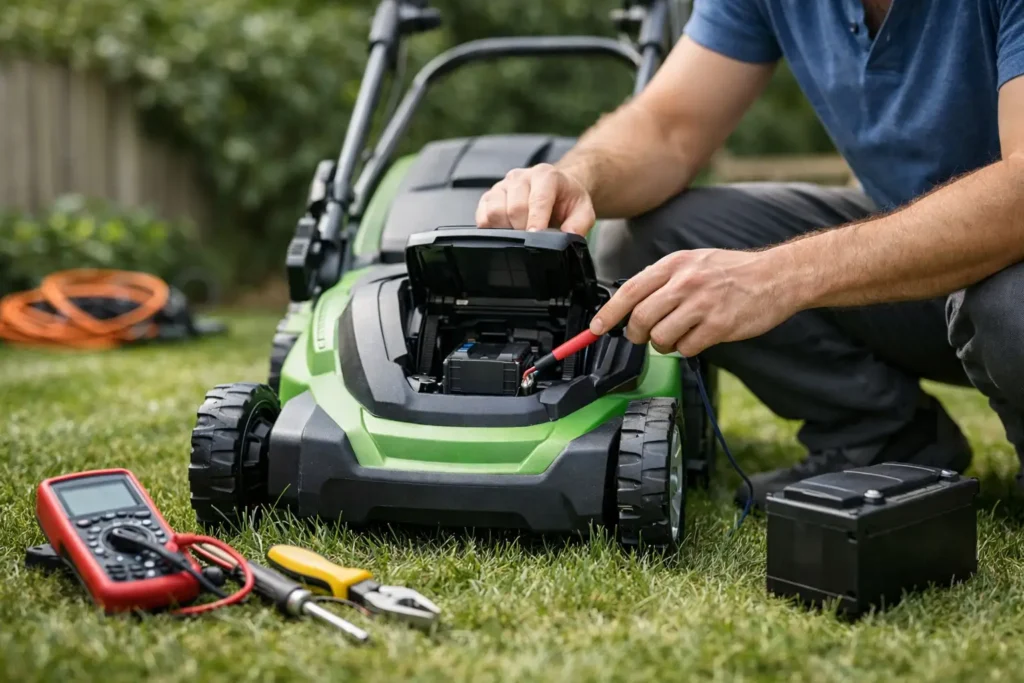
A mower that worked last week and suddenly does nothing can turn a simple yard job into a stalled afternoon. Most electric mower not starting repair comes down to a short list of issues – power supply problems, a tripped safety feature, a jammed blade, or a worn electrical part that needs attention.
That is the good news. Electric mowers are usually more straightforward to troubleshoot than gas models because you can rule out fuel, carburetors, and spark plugs right away. The key is to work in a safe order so you do not miss an easy fix or force a machine that is trying to protect itself.
Electric mower not starting repair begins with safety
Before touching anything underneath the deck or around the blade area, disconnect the mower from power. For corded models, unplug the extension cord from the outlet first, then from the mower. For battery models, remove the battery completely.
Wear gloves if you are checking the blade area. Even when the mower will not start, the blade can still be sharp enough to cut you, and packed grass or a bent branch can hide where your hand is going. If the mower has been sitting outside, give it a minute to dry off before you inspect switches or terminals.
Start with the power source
A surprising number of no-start calls are not mower failures at all. They are power delivery problems. If you have a corded mower, plug something simple like a lamp or drill into the same outlet to confirm the outlet is live. If it is controlled by a GFCI, check whether it has tripped.
Extension cords also matter more than people think. A cord that is too light-duty, too long, or partially damaged can keep the mower from getting the power it needs. Look for cuts, crushed sections, loose ends, or heat damage around the plug. If the mower hums weakly or starts intermittently, the cord may be part of the problem even if it still carries some power.
For battery mowers, begin with the obvious checks. Make sure the battery is fully charged, fully seated, and clean at the contacts. If the charger shows an error or the battery gets very hot during charging, the issue may be in the battery pack rather than the mower itself. Cold weather can also reduce battery performance, so a battery that sat overnight in a cold garage may need time at room temperature before it works normally.
Check the handle and safety system
Electric mowers are built with safety interlocks that stop the blade from spinning if the handle, start button, or bail lever is not in the right position. That makes them safer to use, but it also creates a few common no-start points.
If the folding handle was recently adjusted or collapsed for storage, inspect the joints and cable routing. A pinched cable or loose connection at the handle can interrupt the start circuit. On some models, the handle must lock fully into place before the mower will run. If it feels almost right but not fully seated, that may be enough to stop it.
Next, test the starting sequence exactly as designed. Many mowers require you to press and hold a button while pulling a lever against the handle. If the button sticks, the lever does not return smoothly, or the cable feels slack, the switch may not be engaging. Dirt, corrosion, or normal wear can all cause this.
Look underneath for blade blockage
If the motor tries to start and then stops, or if the mower seems completely dead after cutting heavy grass, check the underside. A dense mat of wet clippings can lock the blade in place. Small sticks, string, and even a compacted layer of old debris can do the same thing.
With the power disconnected, tilt the mower according to the manufacturer guidance and inspect the blade area carefully. Clear away packed grass and remove any debris wrapped around the blade shaft. Then try turning the blade by hand while wearing gloves. It should move with resistance, but it should not feel frozen.
This is also where blade condition matters. A badly bent blade can prevent smooth rotation. A blade that is extremely dull will not usually stop a mower from starting, but it can overload the machine in thick grass and contribute to repeated shutdowns. A sharp, balanced mower blade cuts cleaner, puts less strain on the motor, and helps the whole machine work the way it should.
When the motor is silent versus when it hums
The sound your mower makes during startup tells you a lot. If it is completely silent, focus first on power, battery condition, switches, wiring, and thermal cutoffs. If it hums but the blade does not move, think blockage, seized bearings, or a failing motor capacitor on certain corded models.
A silent mower can still have power if the safety switch or start switch has failed. In that case, the machine may look normal from the outside but never completes the circuit. A humming mower is often trying to run but cannot overcome resistance. That can be a jam, but it can also mean an internal electrical part is weak.
This is one of those areas where it depends on the age and value of the mower. Replacing a switch or clearing a jam is often worthwhile. Replacing a motor assembly on an older budget mower may cost enough that replacement makes more sense.
Electric mower not starting repair for common parts
Once you have ruled out the outlet, cord, battery, safety system, and blade blockage, you are likely dealing with a part failure. The most common candidates are the start switch, safety cable, battery terminals, fuse, thermal overload protector, or the motor itself.
On battery mowers, inspect the battery compartment for corrosion or bent contacts. On corded models, look closely where the power cord enters the mower housing. Repeated pulling and storage stress can loosen internal connections there. If the mower stopped after long use in tall grass, the thermal protector may have tripped. Let the machine cool fully and try again before assuming a major failure.
If the housing needs to be opened to test continuity, trace wiring, or replace electrical components, that is usually the point where many homeowners choose professional help. It is not only a question of skill. It is also a question of time, parts availability, and whether the repair is worth doing compared with the mower’s age.
Do not overlook maintenance issues
People often separate repair from maintenance, but on mowers the two overlap. A neglected deck, dirty vents, worn blade, and stored-outside electrical tool will fail sooner than a clean, sharpened, properly stored one.
Blade maintenance is especially easy to underestimate. A mower with a dull blade tears grass instead of slicing it cleanly, which means longer run times, more drag, and more strain on the motor. If your mower has been bogging down before it stopped starting altogether, the blade may not be the only issue, but it may have helped push the machine in that direction.
Keeping the underside clean, checking cords and batteries regularly, and sharpening the blade on schedule can prevent a lot of startup trouble. For many homeowners, that kind of routine care is the difference between a mower lasting a few seasons and lasting much longer.
When repair makes sense and when it does not
If your mower is fairly new, the battery system is healthy, and the problem is isolated to a switch, cable, or blade obstruction, repair is usually the practical choice. If the motor has failed, the deck is cracked, and the battery is already fading, replacement may be the better investment.
There is also the convenience factor. If you use your mower regularly, downtime matters. A simple repair that gets you back to work fast is valuable. A drawn-out diagnosis with hard-to-find parts is less appealing, especially during peak growing season.
For Seattle-area homeowners trying to keep yard tools in working shape, it often helps to think beyond the single failure. If the mower starts again after a quick fix but the blade is still dull, the machine is not really back in full working order. That is where practical upkeep pays off. Companies like Sharper Tools focus on extending the life of the tools people already own, and that same mindset applies to mower care: fix what failed, sharpen what cuts, and make the next job easier on the machine.
If your mower is not starting, start simple and work forward in order. Power first, safety switches second, blade movement third, and internal parts last. A calm, methodical check usually gets you to the answer faster than replacing random parts – and it gives you a better shot at hearing that mower start when you actually need it.