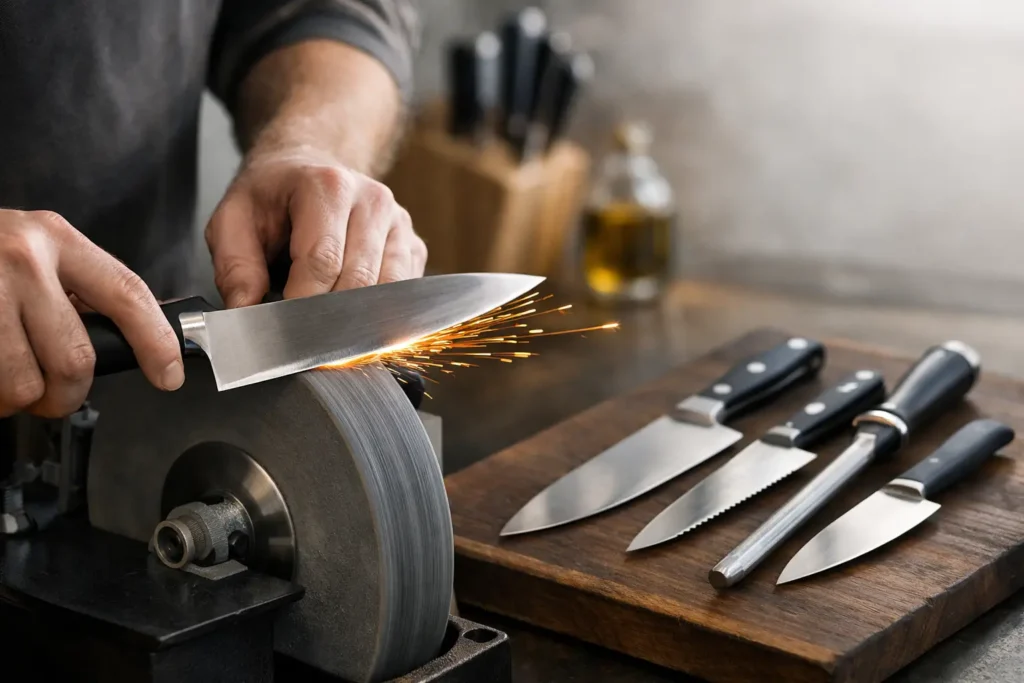
A tomato that squashes instead of slices, an onion that needs repeated passes, or a knife that slides off a pepper are more than small kitchen annoyances. They are clear signs that it may be time to ask: when should knives be professionally sharpened? For most home cooks, the answer comes down to performance, not a date on the calendar. A sharp knife should move through food with control and very little force.
A dull edge makes prep slower and less predictable. It can also be less safe. When a blade will not bite into the food, people naturally press harder or make extra cuts. That is when a knife is more likely to slip. Professional sharpening restores a clean, even edge so the knife can do the work it was designed to do.
When Should Knives Be Professionally Sharpened?
The simplest answer is when regular honing no longer brings the edge back, or when the knife shows obvious signs of damage. For a home kitchen, that may be every six to 12 months. A knife used every day for family meals may need service more often, while a lightly used carving knife may go much longer.
Usage is only part of the picture. The cutting surface, the foods you prepare, the knife’s steel, and how it is stored all affect how quickly an edge wears down. Cutting directly on ceramic, glass, stone, or a plate can dull a knife surprisingly fast. So can leaving it loose in a drawer where it knocks against other utensils.
For a restaurant, catering operation, or busy shared kitchen, waiting for a knife to feel completely dull is usually too late. Knives that see constant prep work need a dependable sharpening schedule. Regular service helps staff work faster, make cleaner cuts, and avoid the disruption of taking several essential knives out of use at once.
The signs your knife needs more than a quick tune-up
A knife does not have to be totally blunt before it needs attention. Watch for changes in how it performs. If it tears herbs instead of cleanly cutting them, struggles to start a slice through a ripe tomato, or crushes soft fruit, the edge is likely worn. Another common clue is steering. If a knife pulls to one side during a straight cut, the edge may be uneven.
Look closely at the blade under good light, too. A sharp edge is so thin that it is difficult to see. Bright spots along the cutting edge often indicate flat, rolled, or chipped areas catching the light. Small chips, a bent tip, or an edge that feels rough are all good reasons to bring the knife to a professional rather than trying to correct it aggressively at home.
The paper test can be useful, but it is not the only test that matters. A knife may cut paper yet still perform poorly on food. The best real-world check is whether the blade starts a cut cleanly and travels through ingredients without force or sawing.
Honing Keeps an Edge Aligned. Sharpening Rebuilds It.
Many people use the words interchangeably, but honing and sharpening do different jobs. Honing realigns the fine edge that gradually bends during normal use. It removes little to no metal. A honing rod or other suitable honing tool can help a knife feel better between sharpenings, especially in a busy kitchen.
Sharpening removes a small amount of metal to create a new cutting edge. That is necessary once the original edge has become worn, rounded, chipped, or uneven. A honing rod cannot fix a genuinely dull knife. In fact, repeatedly honing a dull blade can create the impression that you are maintaining it while the actual cutting problem remains.
A practical home routine is to hone as needed, use a proper cutting board, wash and dry knives by hand, and schedule professional sharpening when the blade stops responding to honing. This approach protects the knife and avoids over-sharpening it. Every sharpening removes material, so good edge maintenance is about restoring what is needed, not grinding away more blade than necessary.
How often is often enough?
There is no single schedule that fits every knife. A home cook who prepares dinner most nights might have their main chef’s knife and paring knife professionally sharpened once or twice a year. A serious home cook who does large batch cooking, frequent baking, or weekend entertaining may benefit from more frequent service.
Commercial kitchens have different demands. Prep knives can lose their best working edge quickly when they are used for hours each day. Many operations benefit from a planned rotation rather than waiting for staff to flag a problem. A service such as Knife Swap & Go can keep consistently sharp knives in circulation while reducing interruptions during prep and service.
Outdoor and utility use can shorten the interval as well. A knife used for cardboard, packaging, or other non-food tasks will dull faster than one reserved for a cutting board. That is also a reason to keep kitchen knives for food prep only. The edge geometry that works well for slicing vegetables is not meant for prying, scraping, or cutting hard materials.
When Professional Sharpening Is the Better Choice
At-home sharpeners can be useful for light maintenance, but they come with trade-offs. Pull-through sharpeners are quick, for example, yet some remove more metal than needed or create a coarse, inconsistent edge. Inexperienced use of stones can change the blade angle, round over the edge, or leave uneven sections. These mistakes are fixable in many cases, but they can shorten the useful life of a good knife.
Professional sharpening is especially worthwhile for quality kitchen knives, serrated knives, damaged edges, and knives with sentimental or financial value. A trained sharpener can assess the blade, remove chips carefully, restore the proper edge angle, and check for issues such as a broken tip or an uneven bevel. The goal is not simply to make the knife feel sharp for a day. It is to create an edge that cuts well and holds up to normal use.
Serrated knives deserve special attention. They are often neglected because they can still cut for a long time, even when their points and scallops are worn. They also require a different method than a straight-edge knife. A professional can service the individual serrations without flattening the blade’s intended cutting pattern.
Get More Life From a Freshly Sharpened Edge
Once your knives are sharpened, a few ordinary habits can make a noticeable difference. Use wood or quality plastic cutting boards instead of glass, ceramic, or stone. Wash knives promptly and dry them before putting them away. A dishwasher can expose blades to heat, moisture, and contact with other items, all of which are hard on an edge.
Storage matters as much as cutting. A knife block, magnetic strip, blade guard, or drawer organizer keeps blades from banging together in a drawer. Do not toss a freshly sharpened knife into the sink, either. Aside from risking the edge, it creates a safety hazard for anyone reaching into the water.
It also helps to use the right knife for the job. A chef’s knife, paring knife, and serrated bread knife each have a purpose. Using one blade for every task tends to cause unnecessary wear and encourages the kind of twisting or prying that can chip an edge.
For Seattle-area households and businesses, Sharper Tools offers local sharpening support built around the reality that tools need to be ready when you need them. A convenient drop-off or pickup option can make routine edge care easier to keep up with, especially when several household or kitchen tools need service at the same time.
A well-sharpened knife should feel calm in your hand: it starts the cut, tracks where you guide it, and lets you work without forcing it. If your knives are asking for extra pressure or extra patience, that is the right time to give them professional attention.