A tomato that squashes instead of slices is annoying at home. In a busy kitchen, a dull knife slows prep, wears out staff, and raises the chance of slips. That is why a professional knife sharpening guide is less about chasing razor-thin edges and more about keeping your tools safe, predictable, and ready for real work.
Most people wait too long to sharpen. They keep cooking with a knife that drags through onions, tears herbs, and needs extra force on basic cuts. The edge may not look damaged, but performance tells the truth fast. If you have to push harder than usual, your knife is already costing you time and control.
What professional knife sharpening actually means
Professional sharpening is not just making a blade feel sharp for a day or two. It is the process of restoring the edge to the right angle, removing damage carefully, and matching the finish to how the knife will be used. A chef’s knife used every day needs a different result than a slicer, a paring knife, or a heavy utility blade.
That is where experience matters. A good sharpener looks at the steel, blade shape, edge wear, and intended use before removing material. Too aggressive, and the knife gets shorter faster than it should. Too light, and the edge stays weak or uneven. The goal is a durable working edge, not a flashy result that disappears after one dinner service.
For home cooks, that means your favorite kitchen knife comes back easier to use and safer on the cutting board. For restaurants and caterers, it means consistency. Staff should be able to grab a knife and trust how it will perform during prep, service, and cleanup.
Signs your knives need professional sharpening
A knife does not need to be completely blunt before it deserves attention. In fact, sharpening earlier usually preserves more of the blade over time. If the edge slides on tomato skin, crushes green onions, or struggles to start a clean cut, it is a strong sign the knife is overdue.
You may also notice that the knife pulls to one side, leaves ragged cuts, or feels sharp in one section and dull in another. Small chips and rolled spots often show up this way before you can see them clearly. A lot of people call every edge problem dullness, but uneven wear is common, especially on knives used heavily on hard boards or washed carelessly.
For commercial kitchens, the best sign is often workflow itself. If prep takes longer, if line cooks keep reaching for the same one or two decent knives, or if staff starts applying extra pressure, the edges are no longer doing their job.
A professional knife sharpening guide to methods and results
There is no single best sharpening method for every knife. It depends on the blade, the steel, the condition, and how the knife is used. That is one reason professional service is valuable. The right process should fit the knife instead of forcing every blade through the same routine.
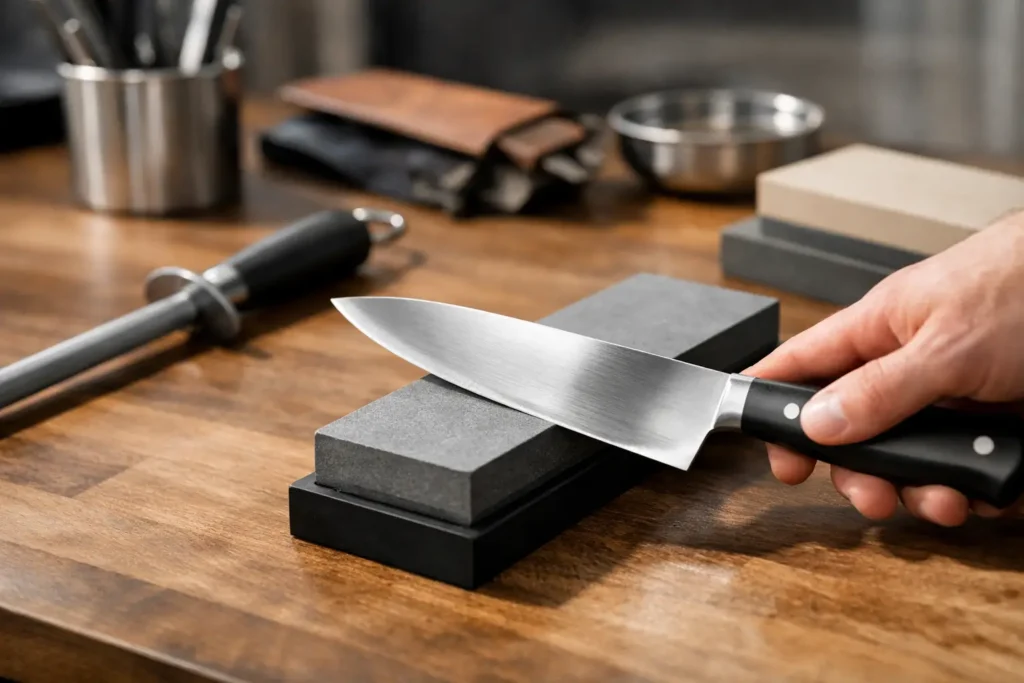
Belt systems can be efficient and effective in trained hands, especially for working knives that need reliable performance fast. Stones offer excellent control and can produce refined edges, but they also take more time and skill. Some blades benefit from a toothier finish that bites into food cleanly, while others do better with a smoother, more polished edge.
The trade-off is simple. Finer edges can feel amazing at first, but they may not hold up as well in rough daily use. More durable working edges may feel slightly less dramatic out of the gate, yet perform better over time. For most households and commercial kitchens, durability matters more than showpiece sharpness.
That is also why professional sharpening is different from running a knife through a cheap pull-through gadget. Those tools may create a quick edge, but they often remove steel badly, leave inconsistent bevels, and shorten the life of the knife. They are fast in the moment and expensive in the long run.
What to expect from a sharpening service
A solid service starts by evaluating the knife, not by making assumptions. The sharpener should check for chips, broken tips, uneven bevels, corrosion, and edge fatigue. Some knives only need edge restoration. Others need repair work before sharpening can even begin.
After sharpening, the knife should cut cleanly and feel stable through the full length of the blade. It should not snag in one area and glide in another. The edge should also suit the knife’s actual job. A home cook’s chef knife, a prep knife in a restaurant, and a utility knife used around the house may all need slightly different treatment.
Turnaround matters too. For homeowners, convenience is the difference between finally handling the job and putting it off for another month. For restaurants, downtime is a real operating problem. That is why local pickup and drop-off or routine service plans can be just as valuable as the sharpening itself.
In the Seattle area, Sharper Tools LLC has built its service around that practical reality. People do not just want sharper knives. They want a trustworthy local option that helps them keep kitchens, households, and businesses moving without extra hassle.
How often knives should be sharpened
There is no calendar date that fits everyone. A home cook using one or two knives a few times a week may only need professional sharpening a couple of times a year. A serious home cook who preps daily may need it more often. In a restaurant, frequency depends on volume, knife quality, cutting surfaces, and whether staff use honing correctly.
Honing and sharpening are not the same thing. Honing realigns a slightly rolled edge between sharpenings. It does not replace lost metal or fix a worn-out bevel. If a knife still feels dull after honing, it is time for actual sharpening.
A useful rule is to pay attention to performance, not guesswork. When clean cuts become effortful, sharpening is due. Waiting until the knife feels almost unusable usually means more work is needed to restore it.
How to make a sharp edge last longer
Good sharpening helps, but everyday habits decide how long the result lasts. Cutting on wood or quality plastic boards is much easier on the edge than glass, ceramic, stone, or metal surfaces. Hand washing is better than tossing knives into a dishwasher where heat, moisture, and contact with other items can wear the edge down fast.
Storage matters as much as use. Loose knives in a drawer bang into tools and hard surfaces every time the drawer opens. A blade guard, knife block, magnetic strip, or dedicated roll protects the edge and lowers the risk of accidental cuts.
Technique counts too. Twisting the blade through hard items, scraping the edge sideways across the board, or using the wrong knife for heavy work shortens edge life. Sharp knives are durable, but they are not indestructible. Using the right tool for the task saves money over time.
When professional sharpening is the better choice
Some people enjoy sharpening their own knives, and with the right equipment and practice, that can work well. But many homeowners do not want the learning curve, and many businesses cannot afford inconsistent results. Mistakes are easy to make. Uneven angles, overheated edges, and too much material removal can do lasting damage.
Professional service makes the most sense when you care about preserving the knife, maintaining consistency, or saving time. It is especially useful if you have better kitchen knives, visible damage, or multiple tools that need attention at once. For restaurants and caterers, dependable service is often less about convenience and more about staying operational.
The same practical mindset applies across other tools too. If your household or business depends on scissors, garden tools, or mower blades, keeping everything maintained by a trusted local service reduces waste and helps tools work the way they should.
Choosing a sharpening provider
A good provider should be clear about what they sharpen, how service works, and what customers can expect. Convenience is worth considering, but it should come with real care and consistent workmanship. Ask yourself whether the service understands both household and commercial needs, whether turnaround fits your schedule, and whether the business treats sharpening as maintenance rather than a quick gimmick.
Local service has real advantages here. You get accountability, easier communication, and a provider who understands how people in your area actually use their tools. That matters whether you are a home cook getting ready for holiday prep or a kitchen manager trying to keep service smooth on a Friday night.
A sharp knife should feel boring in the best possible way. It should do its job cleanly, safely, and without drama. When your tools work the way they are supposed to, everything else gets easier.