A good pair of scissors usually tells on itself before it completely stops working. If you are seeing snagged fabric, bent paper edges, or that annoying need to make the same cut twice, those are often early signs of worn scissor edges. The trouble is that many people assume the scissors are just old and toss them, when a lot of pairs can be restored with the right sharpening and adjustment.
For homeowners, crafters, kitchens, and commercial workspaces, dull scissors waste time in small but constant ways. They slow down prep, make clean work look messy, and can even become less safe because you end up forcing the cut. Knowing what to watch for helps you catch wear early, before the edge gets so far gone that performance really drops off.
The clearest signs of worn scissor edges
The most obvious sign is folding instead of cutting. Paper creases between the blades before it finally tears, gift wrap gets chewed up at the edge, and fabric may pull out of line rather than slice cleanly. When scissors stop shearing smoothly and start acting more like two dull wedges, the edge is usually wearing down.
Another common clue is inconsistent cutting along the blade length. The scissors may cut near the pivot but fail near the tips, or work at the tips and struggle in the middle. That uneven performance often points to edge wear, but it can also mean the blades are slightly out of alignment or the tension has changed. It depends on the pair, which is why a quick inspection matters before assuming the problem is only dullness.
You may also hear the difference. Scissors in good shape tend to feel smooth and controlled. Worn edges often create a scratchy, dragging feel, especially on thinner materials. If cutting starts to feel rough instead of crisp, the edge has likely lost the even contact it needs to shear properly.
Why worn scissor edges act differently than dull knives
Scissors do not cut the same way a straight knife does. They rely on two sharpened edges passing tightly against each other at a set angle. That means even minor wear can show up fast in real-world use. A tiny flat spot, rolled edge, or nick can interrupt the shearing action and make the tool feel much worse than it looks.
This is also why home fixes can be misleading. People sometimes try to cut aluminum foil or other household materials to “sharpen” scissors. At best, that may slightly change how the blades feel for a short time. At worst, it can hide the real issue while continuing to wear the edge unevenly. If the blades are already worn, nicked, or out of adjustment, the problem usually stays put.
7 signs of worn scissor edges you should not ignore
If your scissors are doing any of the following on a regular basis, the edge is likely due for professional attention.
First, they push material forward instead of biting into it. You start the cut, and the paper or fabric slides ahead rather than getting grabbed cleanly.
Second, they leave ragged edges. Instead of a clean line, the cut looks fuzzy, torn, or crushed.
Third, they need extra hand pressure. You find yourself squeezing harder than usual just to get through simple household material.
Fourth, they miss sections during a long cut. You close the blades fully, but a small uncut spot remains.
Fifth, the tips no longer work well. This is especially noticeable when opening packaging, trimming thread, or making precise cuts.
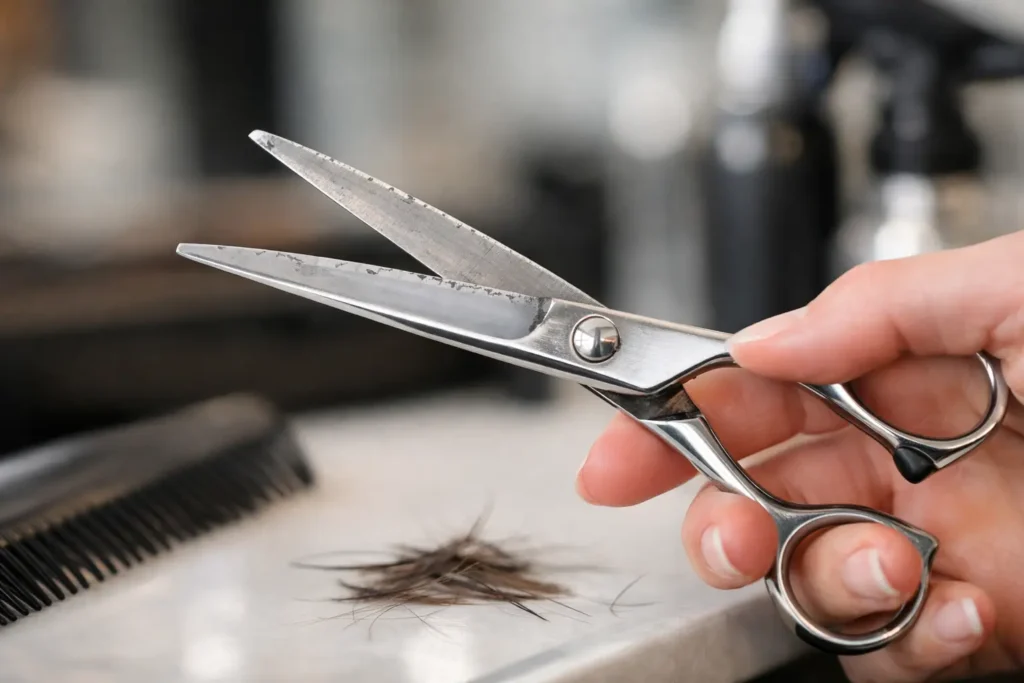
Sixth, you can see visible light wear. Tiny shiny flat spots along the blade edge, small nicks, or areas that reflect light are all signs the cutting edge is no longer consistent.
Seventh, the scissors feel loose or uneven while cutting. This can be edge wear alone, but it often comes with pivot tension or alignment issues that need to be corrected at the same time.
What worn edges look like up close
You do not need a microscope to spot trouble. Hold the blades under a bright light and slowly tilt them. A healthy cutting edge usually appears fine and hard to see. A worn section often reflects light because the edge has flattened. If you notice bright spots, tiny chips, or sections that look polished from friction, that is a strong clue the edge is no longer meeting correctly.
The blade faces can tell part of the story too. Scuffs and residue are normal with use, but deep scratches near the cutting line or signs of blade contact in the wrong place may suggest an adjustment issue. Scissors are a system, not just two sharp edges. Wear in one area can affect how the whole pair performs.
When the problem is not just the edge
Not every bad cut means sharpening alone will fix it. Scissors can struggle because the pivot is too loose, the blades are slightly bent, or the set between the blades has changed over time. If the blades are not meeting with the right pressure, even a freshly sharpened edge may still perform poorly.
That is why proper scissor service usually includes more than grinding the edge. It may involve checking blade ride, alignment, pivot tension, and overall condition. For a well-made pair, that extra attention is often what brings back the clean, easy cut people remember.
The trade-off is simple. A quick DIY attempt may feel cheaper in the moment, but if it removes metal incorrectly or changes the angle, it can shorten the life of the scissors. Professional sharpening is about preserving the tool, not just making it feel sharper for a week.
How different users notice edge wear
In the kitchen, worn scissors usually show up as slipping on herbs, tough packaging, and uneven cuts on food prep tasks. At home, people often notice it first on wrapping paper, school projects, or basic household trimming. In craft and sewing use, the warning signs are harder to ignore because clean edges matter more, and any drag or snag shows immediately.
For light commercial settings, edge wear costs time. Staff members work around a failing tool instead of replacing or servicing it right away. That leads to rougher cuts, slower tasks, and more frustration than most people expect from something as simple as scissors.
Should you sharpen or replace them?
It depends on the quality of the scissors and the condition they are in. A solid pair with good steel is often worth sharpening, especially if the wear is mostly edge-related and the blades can still be adjusted properly. Lower-cost scissors that are heavily worn, bent, or poorly made may not justify the service.
A lot of people underestimate the value of restoring tools they already own. If a pair fits your hand well, has worked reliably for years, or serves a specific task in your kitchen, workspace, or home, sharpening can be the more practical option. It cuts waste, saves replacement shopping, and usually gets the tool back into service faster.
For Seattle-area customers trying to keep everyday tools working without adding errands, that local convenience matters. A service like Sharper Tools can assess whether the scissors are worth saving and handle the edge work and adjustment in a way that matches how the tool is actually used.
How to make sharpened scissors last longer
Once scissors are serviced, daily habits make a real difference. Use them for the material they were meant to cut. Keep adhesive residue off the blades. Wipe them dry after use in the kitchen or garage, and avoid tossing them loose into drawers where the edges bang against other tools.
It also helps to stop using them the moment performance changes noticeably. People often keep pushing through dullness for months, which creates more wear and more frustration. Catching the early signs of worn scissor edges usually means a simpler restoration and better long-term results.
If your scissors are folding, snagging, or missing parts of the cut, they are not being stubborn. They are asking for maintenance, and catching that early is one of the easiest ways to keep a useful tool working like it should.